

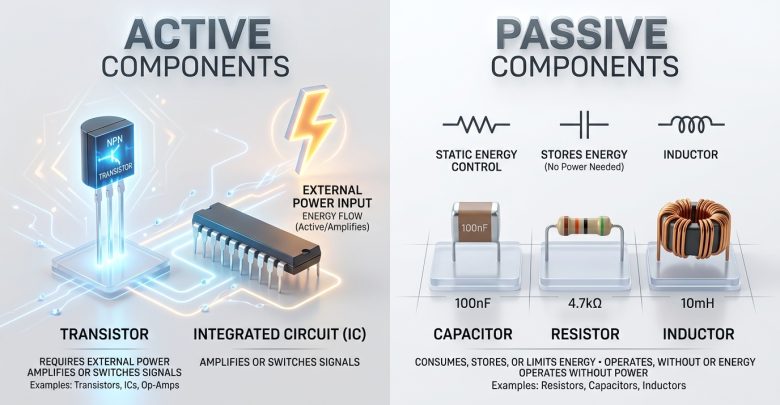
Understanding electronic components is the first step toward efficient project design and hassle-free component procurement. Generally, electronic components are categorized into two main groups: Active and Passive. Understanding the functional differences between these two is essential for anyone working with Printed Circuit Boards (PCBs).
1. What are Active Components?
Active components are electronic parts that can control the flow of electricity. They require an external power source to operate and are capable of amplifying signals or switching electrical currents. Every functional PCB contains at least one active component.
- Key Characteristics: Require external energy; can control current flow.
- Common Examples: Transistors, Integrated Circuits (ICs), Vacuum tubes, and Silicon-controlled rectifiers (SCRs).
2. What are Passive Components?
Passive components are parts that cannot control current or amplify signals using an external electrical signal. They do not require a separate power source to function; instead, they consume, store, or release energy within the circuit.
- Key Characteristics: Do not require external energy to function; cannot amplify signals.
- Common Examples: Resistors, Capacitors, Inductors, Transformers, and Diodes.
Understanding Key Components
Resistors
A resistor is a passive component that opposes the flow of electrical current. It is primarily used to control or limit current levels and to set voltage distribution within a circuit.
Capacitors
A capacitor is a passive component that stores energy in an electrical field between a pair of conductive plates. This process is known as “charging.” Capacitors are classified by their capacitance and are often used to filter out high-frequency or low-frequency signals. When ordering, ensure you select the correct type (e.g., Electrolytic, Ceramic, or Mechanical capacitors) based on your circuit requirements.
Diodes
A diode acts as a one-way valve for electricity. It allows current to flow in only one direction. Most diodes have a colored band (usually white) on one side to indicate the negative terminal and the direction of current flow.
Transistors
Transistors are semiconductor devices and are the building blocks of modern electronics, found in everything from mobile phones to computers. A transistor can be used for voltage regulation, signal amplification, switching, modulation, and oscillation. Some ICs contain over a billion transistors in a tiny area; knowing the exact part number and specifications is crucial to avoid ordering errors.
Integrated Circuits (IC)
An IC is a set of several circuits combined into a single chip. ICs come in a wide variety of packages and sizes, and their functionality varies significantly depending on the specific model.
Tips for Hassle-Free Component Ordering
- Check Datasheets: Always consult the datasheet before ordering to confirm technical parameters.
- Verify Specifications: Beyond the part name, ensure you are selecting the correct package type (SMD or DIP) and voltage/power ratings.
- Identify Components Correctly: Differentiate between passive and active parts based on their function in your circuit.
- Source Quality: Purchase from reliable suppliers to ensure the authenticity and quality of your components, as this directly affects the performance of your PCB.
Tags: #Electronics #ActiveComponents #PassiveComponents #Resistor #Capacitor #Transistor #IC #PCBDesign #ElectronicComponentsGuide