

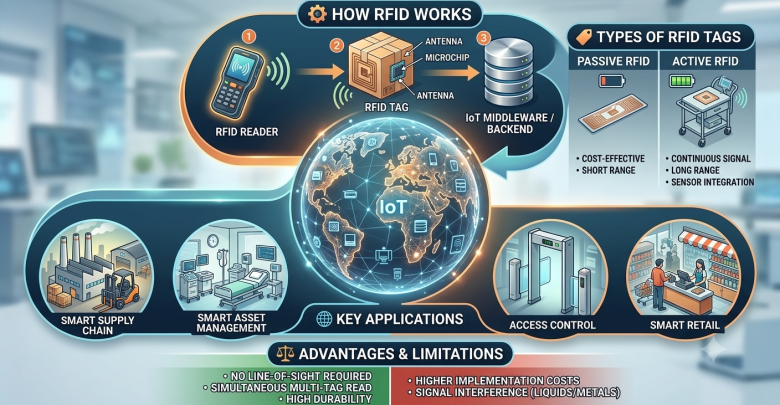
RFID (Radio-Frequency Identification) is a wireless technology that uses electromagnetic fields to automatically identify and track tags attached to objects. In the ecosystem of the Internet of Things (IoT), RFID acts as one of the foundational layers for data collection, bridging the gap between physical items and digital networks.
Unlike traditional barcodes, RFID does not require a direct line of sight to be read, making it highly efficient for automation, logistics, and smart environments.
⚙️ How an RFID System Works
An RFID system consists of three core components:
- RFID Tag (Transponder): Attached to the object, it contains an integrated circuit (microchip) for storing data and an antenna to transmit signals.
- RFID Reader (Interrogator): A network-connected device with an antenna that emits radio waves and receives signals back from the tag.
- Middleware/Backend System: Software that processes the captured data and integrates it with IoT platforms, inventory databases, or enterprise systems.
🏷️ Types of RFID Tags
RFID tags are generally categorized into three main types based on their power source:
- Passive RFID: These tags have no internal power source. They are powered by the electromagnetic energy transmitted from the RFID reader. They are highly cost-effective, thin, and have an almost unlimited lifespan, but feature a shorter read range (up to a few meters).
- Active RFID: Equipped with an internal battery, these tags continuously broadcast their own signal. They offer a much longer read range (up to 100 meters or more) and can support additional sensors (like temperature or humidity monitoring), making them ideal for tracking high-value assets across large areas.
- Semi-Passive (Battery-Assisted Passive): They contain a small internal battery to power the microchip’s circuitry, but still rely on the reader’s power to propagate the radio signal.
🌐 Key Applications of RFID in IoT
- Supply Chain & Logistics: Real-time tracking of goods from factories to warehouses and retail stores, significantly reducing human error and inventory discrepancies.
- Smart Asset Management: Automated tracking of expensive tools, medical equipment in hospitals, or machinery in industries like mining and manufacturing.
- Access Control & Security: Used in smart ID cards, key fobs, and automated toll collection systems (like E-ZPass) for secure and fast authentication.
- Smart Retail: Enabling instant checkout systems, smart fitting rooms, and automated stock alerts when inventory runs low.
⚖️ Advantages and Limitations
Advantages:
- No line-of-sight required; tags can be read through cardboard, plastic, and other materials.
- Capable of scanning hundreds of tags simultaneously in seconds.
- Highly durable and resistant to harsh environmental conditions (dust, moisture, heat).
Limitations:
- Higher implementation costs compared to traditional barcodes.
- Radiofrequency signals can face interference when surrounded by liquids or dense metals.
Tags:
RFID | Radio Frequency Identification | Wireless Technology | IoT Hardware | Asset Tracking | Smart Supply Chain | Internet of Things