


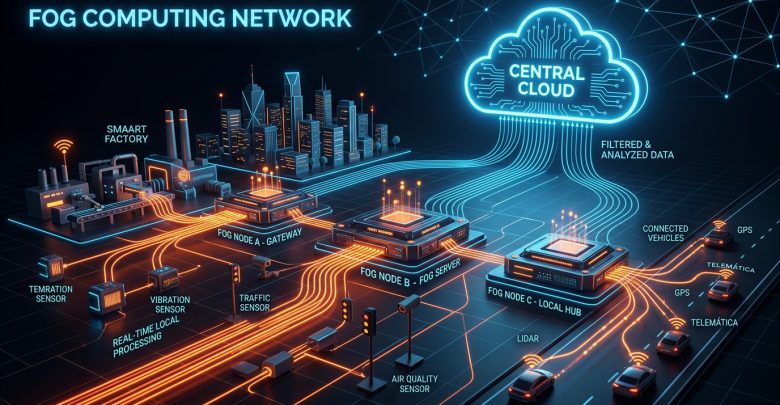
We often talk about the “Cloud” as the ultimate solution for data. But in the world of IoT, the Cloud has significant bottlenecks—latency, bandwidth, and security concerns. This is where Fog Computing (or Edge Computing) comes into play. By processing data closer to the source, we solve the limitations of traditional, centralized architectures.
Here are the six critical reasons why we are moving toward the “Fog”:
1. Minimizing Latency
In industrial production or critical electronic services, even a single millisecond of delay can be the difference between operational success and a major disaster. Analyzing data locally on the device (or an edge gateway) allows for instant decision-making, bypassing the round-trip delay of sending data to a remote cloud server.
2. Bandwidth Optimization
Consider the scale: Oil rigs generate 500GB of data per week, and modern jet engines can produce 10TB of data in just 30 minutes. If every device sent all its raw data to the cloud, our internet infrastructure would collapse. Fog computing filters data locally, ensuring only meaningful insights are sent to the cloud, saving massive amounts of bandwidth.
3. Fortified Security
IoT data is vulnerable during transit and storage. Constant monitoring and automated threat detection are easier to implement at the local edge, where security policies can be strictly enforced before data ever leaves the local network.
4. Reliable Performance
IoT data isn’t just numbers; it drives decisions that impact citizen safety, public infrastructure, and life-critical systems. The integration and availability of these systems cannot be compromised. Localized processing ensures that even if the internet connection is interrupted, the core system continues to function reliably.
5. Managing Distributed Environments
IoT devices are often spread across hundreds of square kilometers—from highways and railways to remote electrical substations. Unlike a controlled data center environment, these devices operate in harsh, unpredictable conditions. Managing them requires decentralized, robust local intelligence that doesn’t depend on constant central connectivity.
6. Intelligent Data Routing
The “best” place to process data depends on the goal. If time is critical, local processing (the Fog) is the primary choice. If we need massive, long-term big data analysis, the Cloud is still the king. A modern IoT architecture smartly routes data: Fog for immediate action, Cloud for long-term insight.
The Verdict: Why Traditional Cloud Falls Short
Traditional cloud computing is great, but it has limits:
- Latency: The physical distance to the data center is a deal-breaker for real-time needs.
- Traffic Jams: Millions of devices flooding the network create bottlenecks.
- Compliance: Industrial regulations and privacy laws often restrict where data can be stored.
- Protocol Diversity: Cloud servers rely on IP-based communication, but IoT devices speak dozens of different, non-IP protocols.
The solution? Bringing the processing power to where the devices actually live. That is the essence of Fog Computing.
SEO Tags & Keywords
Tags: #FogComputing #EdgeComputing #IoTArchitecture #CloudComputing #DataLatency #BandwidthOptimization #IndustrialIoT #DigitalTransformation #TechTrends