

MQTT (Message Queuing Telemetry Transport) is a machine-to-machine (M2M) protocol tailored for Internet of Things (IoT) applications that rely on sensor communication. If you are developing an IoT adapter to transform standard, non-Wi-Fi devices into smart nodes via a simple serial port, understanding MQTT’s underlying framework is essential.
1. The Core Architecture: Publish/Subscribe Model
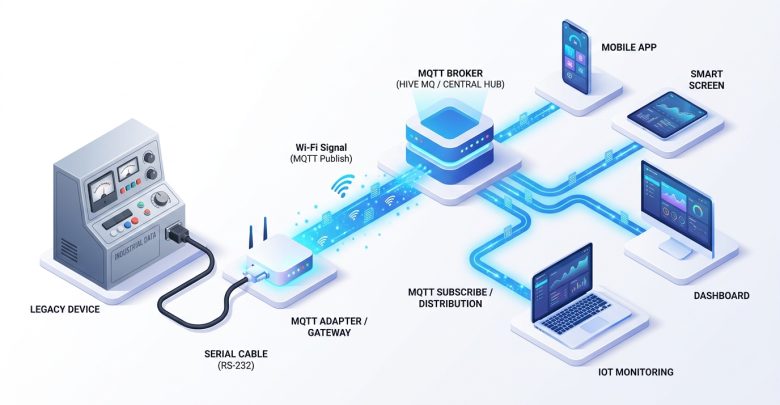
Unlike traditional web protocols that use a direct Client-Server relationship, MQTT relies on a star topology managed by a central hub. This framework is built upon three main pillars:
- The Publisher: The device or node that collects data (e.g., from a sensor) and broadcasts it under a specific label called a Topic.
- The Subscriber: Any device that wants to receive that data simply “subscribes” to the corresponding Topic.
- The Broker (Central Server): The mastermind of the network. It receives all incoming messages, filters them, identifies the active subscribers, and routes the data accordingly.
Analogy: Think of the MQTT architecture like a Telegram Channel. The creator of the channel is the Publisher, the channel itself is the Broker, and the members who join to receive updates are the Subscribers. This prevents the sender from being overwhelmed by direct messages, protecting it from bandwidth exhaustion and DDoS-like overloads.
2. Key Technical Advantages for Low-Power Devices
For hardware nodes with limited processing power and memory, MQTT provides structural benefits:
- Decoupling: The Publisher and Subscriber never interact directly. The publisher does not need to know how many devices are reading its data, drastically lowering the processing overhead.
- Hierarchical (Tree) Topic Structure: Topics in MQTT can have sub-topics using slashes (e.g.,
home/livingroom/temperature). This allows for highly organized data management across thousands of nodes. - Built-in Data Privacy: A Topic remains hidden from the rest of the network until its exact address is shared with a subscriber.
3. Application: Building the IoT Serial Adapter
The main objective of this project is to build an IoT Adapter that allows legacy devices without built-in Wi-Fi to join an IoT ecosystem. The only prerequisite for the target hardware is a functional serial port.
By establishing a clear understanding of the Broker’s behavior, the hardware bridge operates seamlessly:
[Serial Device] <---(UART/Serial Data)---> [Your IoT Adapter] <---(MQTT over Wi-Fi)---> [MQTT Broker]
Using this architecture, your custom adapter handles the heavy lifting of network handshakes, while the base device simply sends raw data over its serial line—creating an affordable, efficient upgrade pathway for legacy hardware.
Tags:
#MQTT #IoT #M2M #EmbeddedSystems #SerialCommunication #UART #IoTAdapter #Networking #Broker #PublishSubscribe