

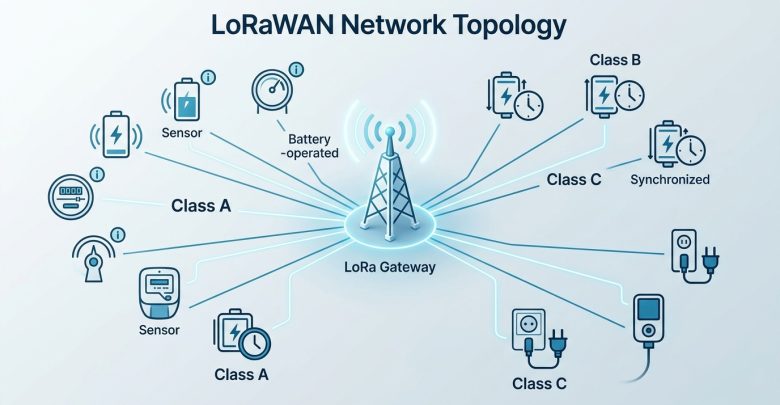
While LoRa provides the physical layer (the radio modulation technique) for long-range communication, LoRaWAN is the protocol that defines the network architecture, communication management, and interaction between Gateways and End-nodes. It is designed to optimize battery life, network capacity, and security.
Device Classes: Matching Energy to Needs
LoRaWAN defines three distinct classes of end-point devices, each balanced for specific application requirements:
Class A: Ultra-Low Power
- Default Standard: Every LoRaWAN device must support Class A.
- Operation: Communication is strictly asynchronous and initiated by the end-device (ALOHA-type protocol).
- Workflow: An uplink transmission is followed by two short downlink windows.
- Efficiency: Devices spend most of their time in “sleep mode,” making them the most energy-efficient class. A single battery can last for years because the device wakes up only when it needs to send data.
Class B: Deterministic Latency
- Operation: In addition to Class A functionality, these devices sync with the network via periodic beacons.
- Latency: They open scheduled “ping slots” for downlink messages.
- Efficiency: While more energy-intensive than Class A, the power consumption is still low enough for long-term battery operation, with a controllable latency of up to 128 seconds.
Class C: Minimum Latency (Always-On)
- Operation: These devices keep their receiver open whenever they are not transmitting.
- Latency: Since the receiver is always ready, the network server can initiate a downlink at any time with virtually zero latency.
- Efficiency: This class is suitable for mains-powered applications or devices that require constant monitoring. Temporary switching between Class A and Class C is possible for tasks like OTA (Over-The-Air) firmware updates.
Data Rates and Network Optimization
LoRaWAN manages network traffic dynamically to balance range and message duration through Data Rate (DR) settings.
Adaptive Data Rate (ADR)
To maximize battery life and network capacity, the LoRaWAN network server uses ADR. This method:
- Individually manages the DR and RF output power for each device.
- Creates “virtual channels” where communications with different DRs do not interfere with each other, effectively increasing the capacity of the Gateway.
Technical Specifications
- Data Rates: LoRaWAN supports bit rates ranging from 0.3 kbps to 50 kbps.
- Frequency Hopping: The protocol uses frequency hopping to minimize interference and improve signal reliability over wide areas.
Key Concepts Summary
| Feature | Class A | Class B | Class C |
| Power Consumption | Lowest | Medium | Highest |
| Latency | Lowest (if uplink driven) | Deterministic (Beacon) | Lowest (Always-on) |
| Use Case | Battery-powered sensors | Periodic reporting | Mains-powered, actuators |
Note on OTA Updates: Over-The-Air (OTA) updates allow for remote maintenance and software upgrades, ensuring that IoT devices remain secure and functional throughout their long service life without physical access.
Tags:
#LoRaWAN #IoT #Connectivity #EmbeddedSystems #EnergyEfficiency #DataRate #ADR #IndustrialIoT #SmartSensors #WirelessNetworking