


IoT Protocols and Standards: A Comprehensive Guide to Interconnectivity
پروتکل ها و استانداردهای اینترنت اشیا هنوز در حال پیشرفت هستند.


The Internet of Things (IoT) landscape is evolving rapidly. While standards are well-established in traditional IT and OT fields, emerging areas—specifically low-power Machine-to-Machine (M2M) communication—are still developing their standardization frameworks. Despite these uncertainties, businesses can leverage existing stable standards to build high-value industrial IoT (IIoT) projects today.
The Evolution of IoT Standards
The idea of connecting and controlling machinery via computers dates back to the 1960s. Thanks to continuous innovation, we can now automate and optimize processes that were unimaginable just two decades ago. IIoT can be viewed as an evolution of existing Operational Technology (OT) standards, even as the market treats it as a new phenomenon.
Categorizing IoT Protocols
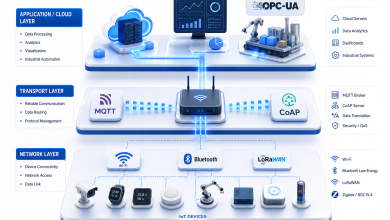
To navigate the complex landscape of IoT, it is helpful to group protocols by their primary function:
1. Infrastructure (The Networking Backbone)
These protocols manage how data is transmitted across networks:
- IPv6: Enables packet interconnection across diverse IP networks.
- 6LoWPAN: An adaptation layer for IPv6 over IEEE 802.15.4 links, specifically for low-power wireless networks.
- UDP: A simple, low-overhead transport layer protocol ideal for real-time applications.
- DTLS: Provides essential security and privacy for datagram protocols, similar to TLS.
- ROLL (RPL): Optimized routing for IPv6 in low-power and lossy networks.
2. Discovery (Finding Devices)
These allow devices to seamlessly detect one another in a network environment:
- mDNS: Resolves hostnames to IP addresses in networks lacking a local name server.
- Physical Web: Uses Bluetooth (BLE) beacons to broadcast URLs to nearby users.
- UPnP: A protocol suite for seamless device discovery and service sharing.
3. Data Protocols (Managing Communication)
These dictate how data is exchanged between applications:
- MQTT: A lightweight publish/subscribe model perfect for low-bandwidth environments.
- CoAP: A RESTful application layer protocol designed for resource-constrained IoT devices.
- AMQP: A standard open-layer protocol for robust, message-oriented middleware.
- XMPP: An open technology widely used for real-time communication and messaging.
- Websocket: Enables full-duplex communication sockets between clients and servers.
Conclusion
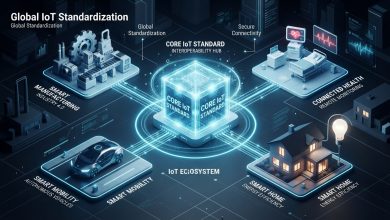
While the IoT ecosystem continues to grow—with over 30 emerging standards identified by Gartner—companies do not need to wait for a single universal standard to begin their digital transformation. By choosing from the diverse range of available protocols, businesses can create scalable, secure, and efficient solutions tailored to their specific needs.
What is your experience with IoT protocol selection? Are you using MQTT, CoAP, or another standard for your current project? Share your thoughts in the comments below!
Tags: #IoT #IIoT #TechStandards #Networking #M2M #MQTT #CoAP #IndustrialAutomation



اطلاع رسانی در زمینه ای جدید و مهم مانند iot بسیار کمک به رشد شهر هوشمند است
سلام ،ممنون از همراهی شما
در ادامه مطالب بیشتری راجع به شهر هوشمند و کاربردهای دیگر اینترنت اشیا در سایت خواهیم داشت
موفق و پیروز باشید