


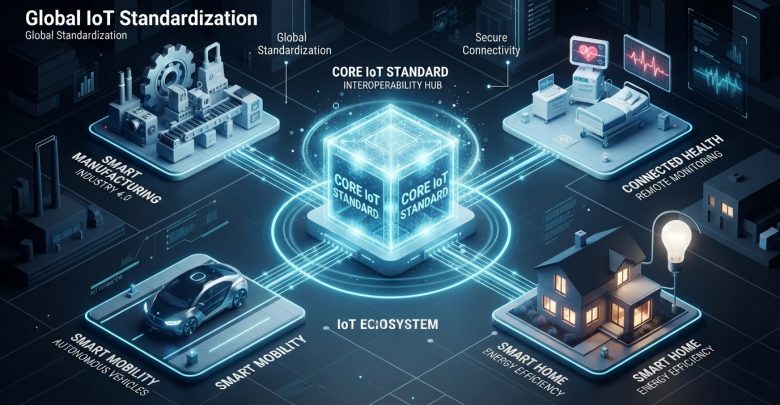
Interoperability is the cornerstone of the Internet of Things (IoT). To ensure that diverse devices, networks, and applications communicate seamlessly, global organizations have developed open standards. This guide categorizes the key standards and their governing bodies that define the current IoT landscape.
IoT Standards and Governing Organizations
The following table summarizes the primary organizations and the standards they provide to ensure robust IoT connectivity and data exchange.
| Organization | Standard/Focus | Key Contribution |
| Auto-ID Labs | RFID & Auto-ID | Networked RFID and emerging identification technologies. |
| EPCglobal | EPC Standard | Standardizing the Electronic Product Code (EPC) for supply chains. |
| FDA | UDI System | Unique Device Identifiers for medical devices. |
| GS1 | UID & RFID | Global standards for identification of consumer goods and healthcare products. |
| IEEE | IEEE 802.15.4 | Defining foundational communication technologies for low-power networks. |
| IETF | TCP/IP Suite | Developing the core internet protocols that power IoT data routing. |
| MTConnect | MTConnect | Standard for data exchange in industrial manufacturing equipment. |
| The Open Group | O-DF | Open Data Format for universal object information modeling. |
| The Open Group | O-MI | Open Messaging Interface for key IoT operations (e.g., publish/subscribe). |
| OCF | OCF Standards | Connectivity for simple devices utilizing the CoAP protocol. |
| OMA | OMA-DM/LWM2M | Management of IoT devices and secure application frameworks (GotAPI). |
| XSF | XMPP | Extending open-standard instant messaging protocols for IoT data. |
Deep Dive into Critical IoT Standards
Industrial & Production Connectivity
- MTConnect: Vital for Industry 4.0, this standard facilitates seamless data exchange between machine tools and industrial software, allowing for predictive maintenance and operational optimization.
Data Modeling and Messaging
- O-DF (Open Data Format): Released in 2014, O-DF provides a universal structure to describe any “object” within an IoT ecosystem, acting as a standardized vocabulary for devices.
- O-MI (Open Messaging Interface): Working in tandem with O-DF, O-MI defines essential operations such as “Read,” “Write,” and “Cancel,” including robust Pub/Sub (Publish/Subscribe) mechanisms that are critical for asynchronous IoT data flows.
Device Management and Security
- OMA (Open Mobile Alliance): Provides LWM2M (Lightweight M2M), an industry-standard protocol specifically designed for remote management of constrained IoT devices, and GotAPI, which provides a secure framework for cross-platform IoT application development.
- OCF (Open Connectivity Foundation): Focuses on device-to-device interoperability, leveraging the CoAP (Constrained Application Protocol) to ensure that low-power devices can communicate over IP networks without excessive overhead.
Why Open Standards Matter for IoT
Adopting these open standards is essential for businesses and developers for three main reasons:
- Interoperability: Prevents vendor lock-in and allows devices from different manufacturers to work together.
- Scalability: Standardized protocols like TCP/IP and CoAP allow networks to expand from a few devices to millions without architectural collapse.
- Future-Proofing: Open standards are maintained by global communities, ensuring long-term support and adaptation to new technological threats and requirements.
Tags:
#IoTStandards #IndustrialIoT #O_DF #O_MI #IEEE #MTConnect #LWM2M #Interoperability #IoTConnectivity #CoAP