


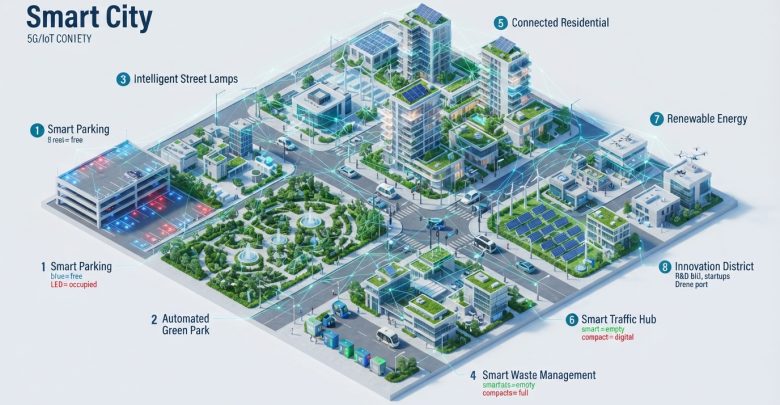
Integrating Information Technology services through the Internet of Things (IoT) provides secure, optimized methodologies for managing complex urban processes and daily municipal activities. By leveraging real-time data ingestion and automated decision-making, cities can transition into efficient “Smart Cities.”
This article explores four pivotal IoT urban verticals, supported by real-world implementation case studies.
1. Smart Curbside Parking Systems
Urban congestion is often exacerbated by drivers searching for parking. IoT-enabled smart parking solves this by providing real-time occupancy data.
- Implementation Example: In Dubai, the “Smart Parking” project utilizes ground-based sensors installed in curbside parking spaces. These sensors transmit real-time availability data via the Sigfox network to a centralized platform, allowing drivers to locate and navigate to vacant spots through a mobile application.
Key Achievements:
- Traffic Control: Significant reduction in traffic flow disruption caused by cruising for parking.
- Optimized Utilization: Maximized usage of existing curbside infrastructure.
- Efficiency: Drastic reduction in time spent searching for parking.
2. Smart Irrigation Systems
Water scarcity and resource management are critical urban challenges. Smart irrigation uses environmental data to automate landscaping maintenance.
- Implementation Example: The project at Centre de Poblenou Park utilizes a network of sensors to monitor soil moisture, salinity levels, wind speed, and ambient temperature. This data is processed by specialized software to trigger irrigation only when necessary.
Key Achievements:
- Resource Conservation: Achieved a 25% reduction in water consumption.
- Operational Efficiency: Optimized the allocation of human resources.
- Climate-Adaptive: Irrigation schedules are automatically adjusted based on real-time plant needs and weather conditions.
3. Smart Lighting Systems
IoT-enabled lighting transforms streetlights from passive infrastructure into active, managed assets.
- Implementation Example: In London, the “Lighting Power Grid Monitoring” project retrofitted 65% of the city’s streetlights with the Philips CityTouch management system, allowing for centralized monitoring and dynamic adjustment of light intensity.
Key Achievements:
- Energy Efficiency: Realized a 63% reduction in energy consumption.
- Cost Savings: Annual operational and maintenance savings of $9.5 million.
4. Smart Waste Management
Traditional waste collection often involves unnecessary trips to empty bins. IoT-based smart waste management optimizes routes based on fill levels.
- Implementation Example: The “Smart Rubbish Bins” project in Barcelona, Spain, equipped street-level bins with fill-level sensors. When a bin reaches a threshold, the system alerts the central hub, which then calculates the most efficient route for collection vehicles.
Key Achievements:
- Cost Reduction: Minimized fuel and vehicle wear by streamlining collection routes.
- Public Hygiene: Improved urban cleanliness by preventing bin overflows.
- Logistics Optimization: Dynamic route calculation for collection fleets.
Conclusion
The application of IoT across these four verticals demonstrates a clear path toward more sustainable, efficient, and livable cities. By moving from static infrastructure to data-driven urban management, municipalities can reduce operational costs, conserve vital resources, and significantly enhance the quality of life for their citizens. As technology continues to scale, these IoT frameworks will become the foundational standard for modern urban governance.
Tags:
Smart City | IoT Urban Management | Smart Parking | Smart Irrigation | Intelligent Lighting | Waste Management | Urban Efficiency | Sigfox | Philips CityTouch | Predictive Maintenance