
The Architect’s Blueprint: A Deep-Dive Guide to IoT Communication Protocols for Enterprise Infrastructure

In the modern enterprise landscape, the Internet of Things (IoT) serves as the digital neural network linking billions of decentralized systems. Building a scalable, industrial-grade IoT ecosystem is not merely a matter of deploying physical devices; it hinges fundamentally on selecting the correct underlying communication protocols.
Every architectural decision made at the network, transport, or application layer dictates the system’s long-term reliability, power budget, payload throughput, and cybersecurity posture. Siloed or poorly matched protocols lead directly to network congestion, hardware strain, and systemic vulnerabilities.
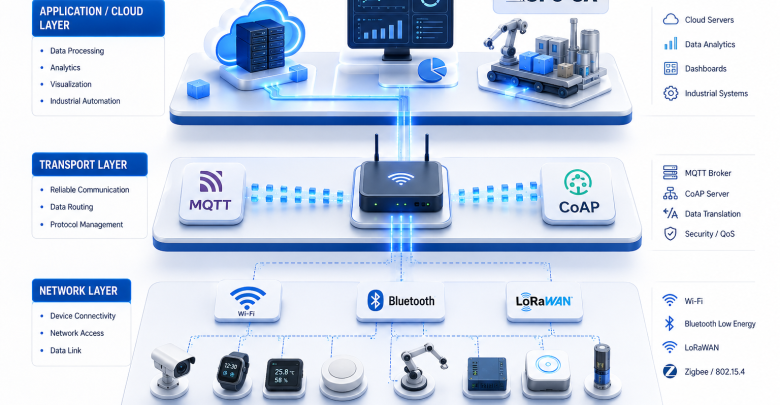
To satisfy the modern requirements of data-driven intelligence and secure edge computing, enterprise systems engineers must systematically evaluate connectivity models across a standardized, multi-layered framework.
Layer 1: Network & Connectivity Protocols
The network layer governs the physical and data-link infrastructure of an IoT deployment. It defines the wireless or wired mediums through which decentralized edge nodes transmit raw packets to localized hardware gateways or wider commercial telecommunication infrastructures.
Wi-Fi (IEEE 802.11)
Wi-Fi is the standard for high-bandwidth local area networks, delivering exceptionally high data transfer rates. Because it integrates natively with established IT network infrastructures, it requires no proprietary gateway translation software.
- Architectural Trade-offs: The high radio frequency and payload capacity of Wi-Fi demand a rigorous power budget, causing immediate battery depletion on isolated nodes. Furthermore, standard high-frequency signals suffer from limited structural penetration.
- Primary Enterprise Implementations: Restricted to mains-powered assets, continuous indoor high-definition video surveillance feeds, and high-throughput industrial machinery control units.
Bluetooth Low Energy (BLE)
BLE was engineered explicitly to handle low-duty-cycle communication across short distances while maintaining an extremely compact physical and power footprint.
- Architectural Trade-offs: To achieve its multi-year battery lifecycles, BLE restricts payload sizes and data transmission frequency. Its localized nature requires a high density of receiver beacons if deployed across large corporate spaces.
- Primary Enterprise Implementations: Wearable medical diagnostic telemetry devices, employee proximity safety monitoring, and precision indoor asset positioning beacons.
Zigbee & Z-Wave
These protocols utilize low-power wireless mesh topologies. Instead of every node communicating directly with a central hub, each asset acts as a wireless repeater, dynamically passing packets along to adjacent devices.
- Architectural Trade-offs: Mesh architectures significantly expand coverage boundaries without requiring higher radio transmission power. However, as the node count grows, the network introduces incremental latency and requires intelligent self-healing routing logic to prevent data bottlenecks.
- Primary Enterprise Implementations: Automated commercial building management systems, centralized climate control grids, and residential smart sensor clusters.
LoRaWAN (Long Range WAN)
LoRaWAN is a prominent Low Power Wide Area Network (LPWAN) technology operating on non-licensed sub-gigahertz radio bands. It trades transmission bandwidth for extreme signal penetration and maximum energy efficiency.
- Architectural Trade-offs: LoRaWAN can push small packets across vast geographical distances and through dense subterranean structures. However, its transmission windows are strictly restricted, rendering it incapable of handling real-time streams or large file packages.
- Primary Enterprise Implementations: Long-range smart agricultural soil tracking, decentralized environmental monitoring grids, and deep subterranean utility infrastructure sensors.
NB-IoT & LTE-M
These carrier-grade LPWAN technologies leverage existing commercial cellular base stations. Operating within securely licensed spectrum bands, they provide high security and comprehensive geographic coverage.
- Architectural Trade-offs: They deliver excellent network penetration and native cellular handover capabilities for moving assets. The trade-off involves recurring carrier subscription costs and higher initial module integration expenses compared to non-licensed radio hardware.
- Primary Enterprise Implementations: Municipal smart utility grid meters, regional logistics tracking, and critical distributed infrastructure monitoring.
Layer 2: Transport & Messaging Layers
Transport protocols supervise how data payloads are packaged, addressed, routed, and verified as they travel across network links between edge gateways, processing brokers, and cloud data repositories.
MQTT (Message Queuing Telemetry Transport)
MQTT is an asynchronous, broker-based publish-subscribe messaging architecture. It features an incredibly small packet header overhead, making it uniquely suited for bandwidth-constrained, high-latency, or unreliable network connections.
- Structural Mechanics: Edge clients publish data to a centralized broker on specific “topics.” Enterprise applications subscribe to those same topics, decoupling the physical device from the consuming software.
- Primary Enterprise Implementations: Continuous remote pipeline telemetry tracking, asset health streaming, and real-time cloud data ingestion pipelines.
CoAP (Constrained Application Protocol)
CoAP brings the familiar request-response REST paradigm of HTTP down to highly constrained, battery-operated microcontrollers. Running natively over UDP rather than TCP, it eliminates the heavy connection-handshake overhead that strains low-power hardware.
- Structural Mechanics: CoAP integrates cleanly with standard web architectures via simple proxy mapping, enabling direct interaction with resource-constrained nodes using traditional internet commands.
- Primary Enterprise Implementations: Direct machine-to-machine polling, battery-isolated environmental sensing nodes, and remote technical assets requiring low connection overhead.
HTTP & WebSockets
The foundational pillars of the world wide web. WebSockets provide persistent, full-duplex communication channels that allow bidirectional data to flow instantly without the continuous overhead of opening new HTTP headers.
- Structural Mechanics: While highly compatible with standard corporate firewalls and web applications, the substantial text-based header format consumes heavy bandwidth and computing power.
- Primary Enterprise Implementations: High-level IoT configuration dashboards, user-facing control panels, and cloud-to-cloud data synchronization.
AMQP (Advanced Message Queuing Protocol)
An enterprise-grade, peer-to-peer queuing protocol focusing on absolute message reliability, complex transaction routing, and cryptographic security.
- Structural Mechanics: Unlike MQTT, AMQP guarantees strict message delivery confirmations, parsing, and queue management across multi-tiered corporate environments, trading lightweight efficiency for maximum data certainty.
- Primary Enterprise Implementations: Industrial supply chain logistics, financial transaction processing within automated commerce, and core business system integrations.
Layer 3: Application & Industrial Layers
Application layer frameworks define the exact semantic data schemas and object models used by edge systems, ensuring that completely different hardware components interpret complex data payloads identically.
OPC-UA (Open Platform Communications Unified Architecture)
The cross-platform, open standard for industrial automation. OPC-UA goes far beyond raw messaging; it incorporates rich information modeling that embeds the exact context, engineering units, and structural metadata alongside the raw data value.
- Structural Mechanics: It features native, end-to-end cryptographic encryption, user authentication controls, and complete vendor-agnostic interoperability, enabling seamless machine-to-machine communication.
- Primary Enterprise Implementations: Programmable Logic Controller (PLC) orchestration, heavy process manufacturing plants, and unified smart factory automation.
DDS (Data Distribution Service)
A highly decentralized, peer-to-peer data-bus architecture designed for ultra-low latency, real-time deterministic performance.
- Structural Mechanics: DDS eliminates the single-point-of-failure risks associated with centralized brokers by allowing nodes to discover each other dynamically. It enforces strict Quality of Service (QoS) parameters, ensuring guaranteed data delivery within millisecond thresholds.
- Primary Enterprise Implementations: Autonomous vehicle collision avoidance arrays, defense and aerospace telemetry, and high-speed smart grid robotics.
Comprehensive Protocol Trade-Off Matrix
Selecting an IoT protocol suite requires a systematic balancing of hardware, power, and bandwidth limitations. The matrix below contrasts the operational profiles of each major technology:
| Protocol Name | Connectivity Scope | Power Consumption | Payload Throughput | Standard Security | Primary Architectural Use Case |
|---|---|---|---|---|---|
| Wi-Fi | Local / Medium | High | Very High | Robust | Mains-powered asset tracking, indoor video surveillance |
| BLE | Short Range | Low | Medium | Moderate | Wearable health monitors, localized asset tracking |
| Zigbee | Short / Mesh | Low | Low | Moderate | Commercial smart building automation grids |
| LoRaWAN | Long Range | Extremely Low | Minimal | Basic | Remote smart agriculture, wide urban telemetry |
| NB-IoT | Long / Cellular | Low | Low | High | Municipal smart utility meters, regional logistics |
| MQTT | Transport Layer | Low | Medium | Moderate | Asynchronous cloud telemetry, remote monitoring |
| CoAP | Transport Layer | Extremely Low | Low | Basic | Low-power microcontrollers, isolated field sensors |
| AMQP | Transport Layer | Medium | High | High | Inter-enterprise system queues, business logistics |
| OPC-UA | Application Layer | Medium | High | High | Heavy industrial automation, machine-to-machine integration |
| DDS | Application Layer | High | Extremely High | High | Autonomous vehicle systems, high-speed robotics |
The System Architect’s Decision Framework
When designing a production IoT infrastructure, engineers should follow this step-by-step decision matrix to ensure alignment with operational constraints:
Step 1: Establish Power and Lifespan Realities
- Constraint: Is the edge node completely isolated, relying on an internal battery cell or ambient energy harvesting for a multi-year lifespan?
- Action: Restrict the architecture to LoRaWAN, CoAP, or NB-IoT. If the node has continuous access to stable mains electricity, prioritize high-bandwidth options like Wi-Fi or HTTP/WebSockets.
Step 2: Evaluate Geographic and Structural Dispersion
- Constraint: What is the physical distance between the data-generating node and the receiving infrastructure?
- Action: For enclosed indoor spaces like offices or logistics hubs, deploy Zigbee or BLE. For expansive outdoor spaces spanning municipal infrastructure or agricultural fields, mandate LPWAN cell models.
Step 3: Define Latency and Determinism Thresholds
- Constraint: Does a delay of a few milliseconds jeopardize physical safety or cause mechanical damage?
- Action: Implement a decentralized peer-to-peer DDS data-bus for real-time autonomous systems. For standard, asynchronous monitoring where occasional network lag is acceptable, opt for MQTT.
Step 4: Confirm Industrial Interoperability
- Constraint: Does the network need to query or control complex legacy factory hardware, PLCs, or manufacturing execution systems?
- Action: Standardize completely on OPC-UA at the application layer to guarantee native data structure compatibility, preventing data corruption during transmission to enterprise ERP platforms.
The Edge-to-Cloud Paradigm
Modern enterprise deployments are moving away from rigid, single-protocol silos. Instead, successful deployments leverage hybrid gateway topologies.
In these advanced setups, local edge gateways ingest data from legacy hardware using low-latency, deterministic protocols like OPC-UA or Zigbee, convert and compress the payloads at the edge, and then securely stream them to cloud environments via lightweight, asynchronous transport protocols like MQTT. This layered strategy ensures optimal power management at the edge, minimal bandwidth utilization across the network, and absolute data sovereignty across the entire enterprise.
Tags:
IoT Protocols | MQTT vs CoAP | Industrial IoT Topology | LoRaWAN LPWAN | OPC-UA Automation | NB-IoT Cellular | Network Architecture | Edge Connectivity | Data Distribution Service | Smart Grid Telemetry