

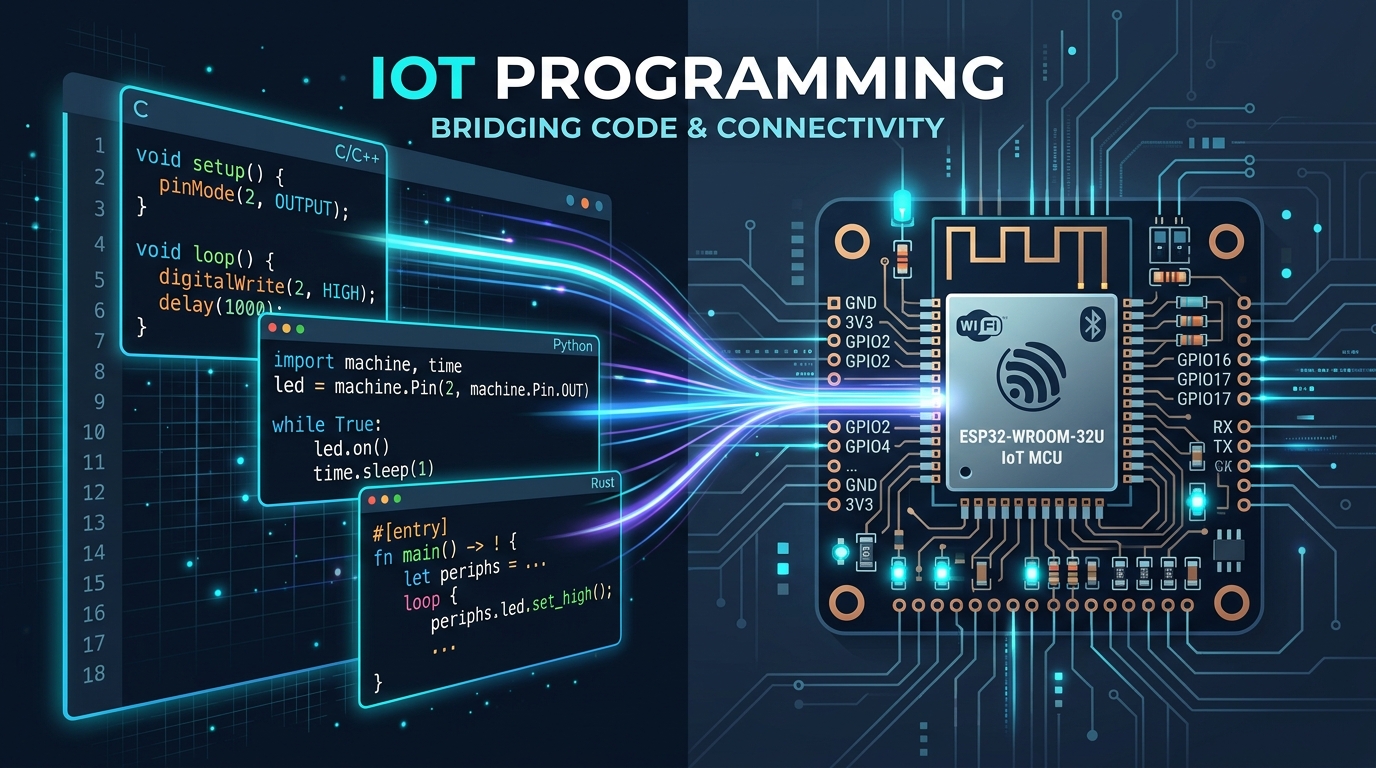
IoT projects are incredibly exciting for students and beginners. The ability to connect physical objects to the digital world is a fascinating experience. However, choosing the right hardware and software for your IoT project is a tough decision. While there are many hardware options, selecting the best programming language is equally challenging.
Here is a breakdown of the 10 programming languages to help you start your IoT career:
1. C: The Classic Choice
As the first language for many beginners, C remains a top priority. Its effectiveness in IoT stems from its origins in telecommunication switching. It can be used for most embedded system platforms, either directly or through an SDK. It is easy to learn and highly efficient.
-
Weakness: Code must be compiled, not interpreted. Lacks built-in GUI libraries.
-
Best for: Low-level hardware programming and RTOS.
2. C++: Object-Oriented Power
Developed by Bjarne Stroustrup, C++ added classes and objects to the core of C. It is a popular choice for IoT, especially in Linux-based environments. Even after 30 years, it remains a robust option for embedded systems.
-
Best for: Advanced embedded systems and IoT Gateways.
3. Python: Readability & Speed
Python is a major player in IoT, particularly for controlling embedded systems. Its high readability and concise syntax make it a favorite for teams focusing on rapid development.
-
Best for: Rapid prototyping, Edge analytics, and AI in IoT.
4. Java: Portability & Reliability
Java is an object-oriented language known for being “portable” (run anywhere). Its Virtual Machine (JVM) requires minimal hardware resources, and it covers a wide range of libraries, from general use to hardware control.
-
Best for: Enterprise IoT systems and mobile-connected IoT apps.
5. Javascript: Web Interactivity
Designed for web frontends, Javascript is a great starting point if your IoT project involves web interaction (e.g., Raspberry Pi sensor data dashboards).
-
Note: It is not suitable for lightweight, low-level embedded controllers.
-
Best for: IoT dashboards and web-based device control.
6. GO (Golang): High-Performance Concurrency
Developed by Google, GO is similar to C but superior for modern embedded systems. It excels at gathering and sending data across various channels using hash-algorithm-secured tables.
-
Best for: Backend services for processing large volumes of IoT data.
7. Rust: Safety First
Developed by Mozilla, Rust addresses the “data race” issues found in languages like GO. Its internal functions prevent systems from going out of control during concurrent processing, making it ideal for high-reliability IoT applications.
-
Best for: Secure embedded systems and reliable IoT firmware.
8. Parasail: Parallel Processing Specialist
If your IoT application depends on parallel code, Parasail is the best choice. It is a compiled, object-oriented language with syntax similar to Java and Python, designed specifically for parallel execution.
-
Best for: Intensive computations and image processing in high-end IoT devices.
9. B#: Efficiency for Small Memory
B# was developed to be an efficient language for small-scale embedded systems. Running on an Embedded Virtual Machine (EVM) that consumes only 24K of memory, it is perfect for resource-constrained applications.
-
Best for: Simple sensors and devices with very limited memory.
10. Assembler: Maximum Compression
Use Assembler when you need your application to be as compact as possible. It simplifies execution to the bare minimum. However, it lacks extensive library support, making it a “do-it-yourself” challenge.
-
Best for: Hardware drivers, bootloaders, and extreme micro-controller optimization.
Tags: #IoT #ProgrammingLanguages #InternetOfThings #EmbeddedSystems #TechEducation #SoftwareDevelopment #IoTDevelopment #Coding #SmartTechnology