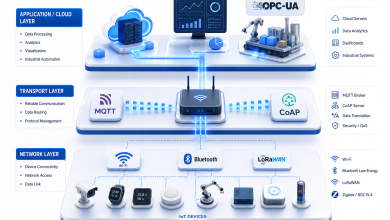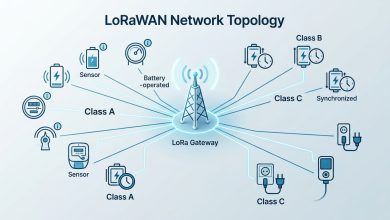



As the Internet of Things (IoT) continues to expand, choosing the right communication protocol is vital. In previous discussions, we explored LPWAN protocols like LoRaWAN and Sigfox. Today, we will examine MQTT (Message Queuing Telemetry Transport), one of the most critical messaging protocols powering the IoT ecosystem.
What is the MQTT Protocol?
MQTT is a lightweight, publish-subscribe network protocol designed for resource-constrained devices. It facilitates machine-to-machine (M2M) communication seamlessly, making it a foundational technology for modern IoT architectures.
Originally created with specific engineering goals in mind, MQTT aims to achieve:
- Simplicity of implementation
- Lightweight and low overhead
- Suitability for unreliable or low-bandwidth networks
- Guaranteed data delivery
Key Features of MQTT
- Binary and Lightweight: MQTT is a binary protocol that transmits data as arrays of bytes. Unlike traditional web protocols like HTTP, it incurs minimal packet overhead, ensuring high-reliability data transfer between resource-limited clients.
- Ideal for Constrained Devices: Thanks to its simple and compact design, it is perfectly suited for low-power, resource-constrained hardware (such as smart bulbs) that need to exchange telemetry with the broader IoT ecosystem.
Comparing MQTT and HTTP
To fully appreciate MQTT, it helps to contrast it with HTTP:
- HTTP (Request-Response): Relies on a direct client-server request-response paradigm. The client sends a request, the server processes it, and returns a response. A continuous connection must be maintained between the two parties during this transaction.
- MQTT (Publish-Subscribe): Decouples the sender and receiver by routing communication through a broker (server). Clients do not connect directly to one another.
Advantages of the Publish-Subscribe Model in MQTT:
- Decoupled Entities: Senders and receivers operate independently without knowing each other’s details, enhancing system reliability. If one client disconnects, only that specific branch of the broker drops, while the rest of the system continues to function.
- Intermittent Connectivity Friendly: Devices do not need to maintain a persistent connection to the broker. A client can publish data and immediately disconnect to save battery (crucial for mobile devices or remote sensors) or enhance security, knowing the broker will handle downstream distribution.
- Data-Centric vs. Document-Centric: HTTP is document-centric (ideal for websites, media, and heavy web services), whereas MQTT is data-centric, designed explicitly for short, lightweight messaging.
- Speed and Efficiency: Measurements in 3G networks show that MQTT can be significantly faster than HTTP. For instance, companies like Facebook utilize MQTT in their messaging platforms to conserve battery life and ensure swift delivery despite unstable mobile networks. Major cloud providers like AWS also support MQTT to bridge IoT devices to the cloud.
- Quality of Service (QoS): MQTT includes built-in QoS levels to guarantee message delivery, making it resilient in unstable or high-latency network conditions.
- Minimal Header Size: MQTT features extremely short headers (with minimum packet sizes as small as 2 bytes), contrasting sharply with text-heavy HTTP headers.
Conclusion
MQTT is the go-to protocol for low-volume data transfer in unstable networks, where low latency, minimal battery consumption, bandwidth efficiency, and high performance are paramount.
#MQTT #IoT #M2M #PublishSubscribe #WirelessProtocols #SmartDevices #CloudComputing #NetworkProtocols #InternetOfThings #TechProtocols