

Supercapacitors are often associated with lithium-ion batteries. In this article, we take a basic look at supercapacitors and examine the pros and cons of using them as energy storage devices.
Introduction to Supercapacitors
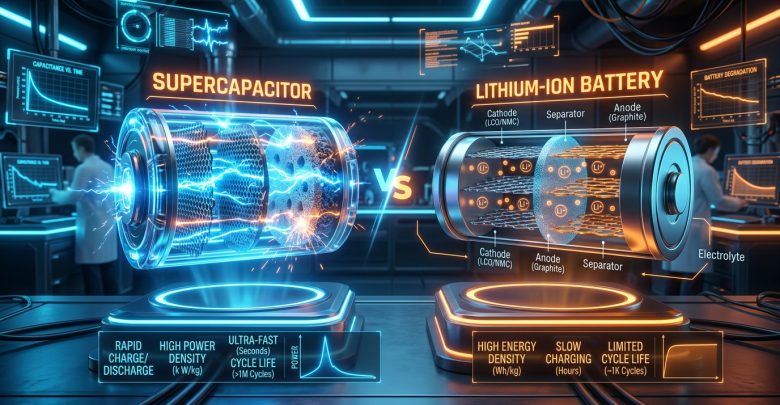
In short, supercapacitors are similar to regular capacitors, but the key difference is their significantly higher capacity. Supercapacitors offer higher capacity and lower voltage compared to other capacitors, placing them functionally somewhere between electrolytic capacitors and rechargeable batteries.
This means that they:
- Charge much faster than batteries.
- Can store vastly more energy than electrolytic capacitors.
- Have a longer lifespan (charge and discharge cycles) than batteries, though shorter than electrolytic capacitors.
- To put their lifespan into perspective: while electrolytic capacitors have an essentially unlimited number of charge cycles and lithium-ion batteries can typically be charged between 500 to 10,000 cycles, supercapacitors boast an astonishing lifespan of 100,000 to 1 million cycles.
Pros and Cons of Batteries and Supercapacitors
Advantages of Supercapacitors
- Rapid Charge and Discharge: While you cannot store as much energy in a supercapacitor as you can in a lithium battery (on average, a supercapacitor stores energy equivalent to about a quarter of its weight), they can be charged at speeds up to 1,000 times faster than a battery.
- Transportation Applications: Supercapacitors are used for rapid charging in certain toys, and companies like Nawa are looking to implement similar ideas in real electric vehicles. Imagine electric cars powered by supercapacitors instead of rechargeable batteries, capable of charging in a fraction of the time.
- Operating Temperature Range: Supercapacitors have higher thermal tolerance and can operate efficiently in extreme temperatures ranging from -40°F to 150°F.
Disadvantages of Supercapacitors
On the flip side, their high energy exchange rate comes with certain limitations:
- Self-Discharge: Supercapacitors are not suitable for long-term energy storage. On average, a supercapacitor loses between 10% to 20% of its stored energy over time on its own.
- Gradual Voltage Drop: While batteries maintain a relatively constant voltage until near depletion, the voltage in supercapacitors drops linearly and proportionally with its load.
Current Applications of Supercapacitors
Because they can handle an immense number of charge cycles and operate reliably in extreme high and low temperatures, supercapacitors are ideal for various conditions. Some notable applications include:
- Public Transportation: Used in hybrid buses and smaller transit vehicles where reliable performance can be guaranteed on both the coldest winter days and the hottest summer days.
Conclusion
Overall, supercapacitors serve as an excellent energy storage solution with an exceptionally high number of charge cycles, offering distinct and powerful advantages over traditional batteries.
#Supercapacitor #Battery #EnergyStorage #IoT #ElectricVehicles #TechTrends