

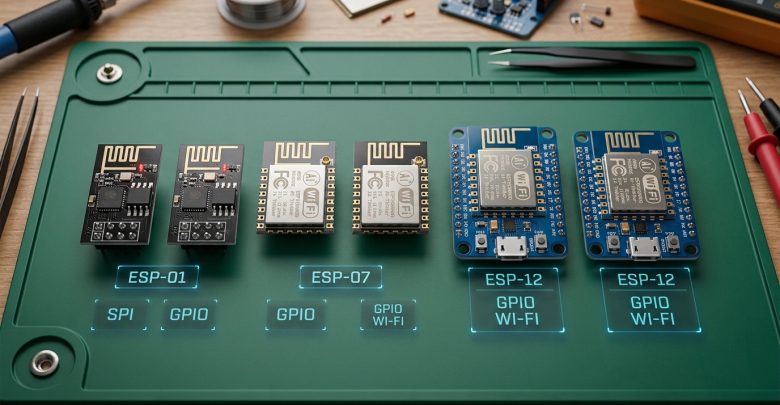
One of the greatest strengths of the ESP8266 ecosystem is the variety of modules produced by Ai-Thinker. While developers often start with feature-rich boards like NodeMCU—which include built-in USB-to-UART converters and voltage regulators—moving to a final product requires a more compact approach.
Prototyping vs. Production
- The Development Phase (NodeMCU): Use these boards to rapidly test code. They simplify development by providing everything you need in one package.
- The Product Phase (Ai-Thinker Modules): Once your design is finalized, you can remove the overhead of extra components by switching to raw Ai-Thinker modules, significantly reducing the size and cost of your end-product.
Comparative Analysis of Ai-Thinker Modules
The following table provides a breakdown of the most popular Ai-Thinker modules to help you choose the right fit for your hardware requirements:
| Module | Active Pins | Form Factor | Antenna Type | Shielded | Flash Size |
| ESP-01 | 6 | 2×4 DIL | PCB trace | No | 512 KiB |
| ESP-01S | 6 | 2×4 DIL | PCB trace | No | 1 MiB |
| ESP-07S | 14 | 2×8 pinhole | U.FL socket | Yes | – |
| ESP-12 | 14 | 2×8 castellated | PCB trace | Yes | – |
| ESP-12E | 20 | 2×8 castellated | PCB trace | Yes | 4 MiB |
| ESP-12F | 20 | 2×8 castellated | PCB trace | Yes | 4 MiB |
| ESP-12S | 14 | 2×8 castellated | PCB trace | Yes | 4 MiB |
Critical Hardware Requirements
Regardless of the module you choose, remember that the raw Ai-Thinker chips are not “Plug & Play” like NodeMCU. To get them running, you must provide:
- Stable 3.3V Power Supply: ESP8266 is sensitive to voltage spikes and current drops.
- USB-to-Serial Converter: Required for programming the firmware via the UART pins (TX/RX).
Final Technical Recommendations
- For Performance: The ESP-12F is widely considered the “gold standard” for production due to its improved antenna performance, integrated shielding, and 4 MiB of Flash memory.
- For Compact Projects: If space is extremely limited and you need external antenna support, look at the ESP-07S.
- Don’t Forget: Always verify your design’s power distribution. A clean 3.3V power supply is the difference between a stable product and random system resets.
Tags: #ESP8266 #AiThinker #NodeMCU #IoTDevelopment #EmbeddedSystems #HardwareDesign #ElectronicsEngineering