
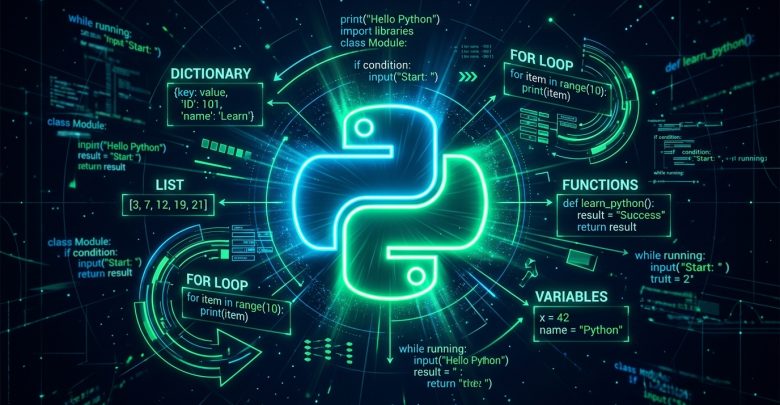
Python has become one of the most popular, versatile, and beginner-friendly programming languages in the world. Whether you want to dive into Artificial Intelligence, web development, data science, or automation, Python is the ultimate launchpad.
If you are looking to pick up Python quickly without wading through months of dense textbooks, this crash course covers the essential fundamentals you need to get coding in record time.
1. Variables and Data Types
In Python, you don’t need to explicitly declare variable types. The interpreter figures it out automatically based on the assigned value.
Python
name = "Alice"  # String (str)
age = 25  # Integer (int)
height = 5.7  # Float (float)
is_student = True  # Boolean (bool)
2. Basic Operators and Strings
Python handles mathematical operations and string manipulation intuitively:
Python
# Math
sum_result = 10 + 5  # 15
product = 4 * 2  # 8
exponent = 2**3  # 8 (2 to the power of 3)

# String Concatenation and F-Strings
greeting = f"Hello, my name is {name} and I am {age} years old."
print(greeting)
3. Conditional Statements (If-Else)
Decision-making in Python relies on indentation rather than brackets:
Python
score = 85

if score >= 90:
  print("Grade: A")
elif score >= 75:
  print("Grade: B")
else:
  print("Grade: C")
4. Loops
Python provides two primary types of loops: for and while.
Python
# For loop iterating through a list
fruits = ["apple", "banana", "cherry"]
for fruit in fruits:
  print(fruit)

# While loop
count = 0
while count < 3:
  print(f"Count is: {count}")
  count += 1
5. Functions
Functions allow you to encapsulate reusable blocks of code using the def keyword:
Python
def calculate_area(length, width):
  return length * width


# Calling the function
room_area = calculate_area(5, 4)
print(f"The area is {room_area} square meters.")
6. Lists and Dictionaries
Data structures are vital for organizing information efficiently.
Python
# Lists (ordered, mutable collection)
colors = ["red", "green", "blue"]
colors.append("yellow")

# Dictionaries (key-value pairs)
student = {"name": "Bob", "age": 22, "major": "Computer Science"}
print(student["major"])
Next Steps
Mastering the syntax is just the beginning. The best way to learn Python is by building projects—start with a simple calculator, a todo-list app, or a basic web scraper.
#Python #Programming #CodingForBeginners #TechEducation #LearnPython #SoftwareDevelopment #WebDev #DataScience