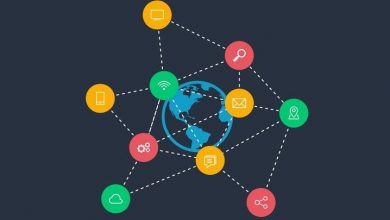


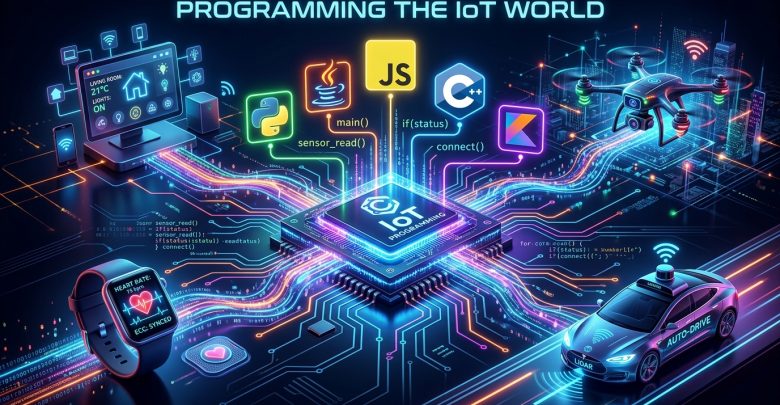
The Internet of Things (IoT) is a vast ecosystem where physical objects—from smart refrigerators to industrial sensors—interact with each other and humans via internet infrastructure. Choosing the right programming language is critical, as it determines how efficiently your hardware communicates, processes data, and scales.
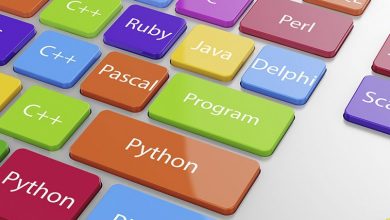
Here is a breakdown of the top programming languages driving the IoT revolution:
1. C: The Hardware-Level Powerhouse
C remains the most fundamental language in IoT.
- Why it matters: It operates at the lowest software layer, closest to the hardware.
- Key Advantage: It does not require high-end processors, making it ideal for microcontrollers and resource-constrained devices where performance and memory management are vital.
2. Java: The Versatile “Write Once, Run Anywhere”
Java is highly regarded for its portability.
- Why it matters: Using the Java Virtual Machine (JVM), developers can write code once and execute it on any chip that supports a JVM.
- Key Advantage: This flexibility makes debugging and deployment across diverse IoT hardware environments seamless.
3. Python: The King of Simplicity and Libraries
Python has transcended web development to become a dominant force in IoT.
- Why it matters: Its clean, readable syntax and extensive library ecosystem allow developers to accomplish complex tasks with fewer lines of code.
- Key Advantage: Its rapid development speed and simple debugging process make it perfect for IoT projects where time-to-market is a priority.
4. JavaScript: Bridging the Web and IoT
Originally created for web interactivity, JavaScript has become a key player in the IoT space.
- Why it matters: It excels at controlling browser-based interfaces and enhancing the design quality of web-based control panels.
- Key Advantage: It significantly simplifies compatibility issues, allowing for smoother interaction across various smart devices and dashboards.
5. Swift: The Apple Ecosystem Gateway
Swift is the go-to language for integrating Apple devices into your IoT infrastructure.
- Why it matters: If you need to manage your smart home hub via iPhones or iPads, Swift is the fastest and most native path.
- Key Advantage: As an open-source, flexible language, Swift offers high performance and ease of use for Apple-centric IoT applications.
6. PHP: Web-Based IoT Management
While primarily a server-side web language, PHP has unique applications in IoT.
- Why it matters: It is widely used to build dynamic web dashboards and manage GPS-based tracking systems.
- Key Advantage: It is excellent for developers who need to integrate real-time location data and performance analytics into web-based management interfaces.
Summary Comparison
| Language | Primary Strength | Best For |
| C | Hardware Efficiency | Microcontrollers, Embedded Systems |
| Java | Portability (JVM) | Diverse hardware, Cross-platform IoT |
| Python | Rapid Development | Prototyping, Data-heavy IoT, AI integration |
| JavaScript | Web Connectivity | Browser-based IoT controls |
| Swift | Apple Integration | iOS/macOS smart home control |
| PHP | Dynamic Web Interfaces | GPS tracking, Web dashboards |
Final Recommendation
While all the above languages are powerful, C, Python, and Java currently stand out as the “Big Three” in the IoT industry. The choice ultimately depends on your project’s hardware constraints, performance requirements, and your existing development ecosystem.
Tags:
#IoT #ProgrammingLanguages #SoftwareDevelopment #Python #EmbeddedSystems #TechGuide #SmartHome #DeveloperTools #TechStack