

In industrial environments, the biggest challenge is interoperability. Unlike standard IoT, Industrial IoT (IIoT) requires systems that can handle rugged environments, real-time data, and extreme reliability. Since different machines often “speak” different languages, choosing the right protocol is the backbone of any successful digital transformation.
Why IIoT Protocols Matter?
In a factory, you have PLCs (Programmable Logic Controllers), sensors, and enterprise-level software (like ERPs) that must talk to each other. A robust protocol ensures:
- Data Integrity: Information is not lost in high-interference environments.
- Real-time Communication: Critical decisions are made in milliseconds.
- Scalability: Adding new machines to the network shouldn’t require a complete overhaul.
Key IIoT Protocols
1. MQTT (Message Queuing Telemetry Transport)
MQTT is the industry favorite for lightweight, low-bandwidth communication.
- Architecture: Publish/Subscribe model.
- Best For: Connecting thousands of remote sensors to a central dashboard.
- Industrial Edge: It is extremely energy-efficient and excels in networks with unreliable connections, as the “Broker” manages message queuing.
2. OPC UA (Open Platform Communications Unified Architecture)
If MQTT is the “messenger,” OPC UA is the “encyclopedia.” It is the gold standard for secure, machine-to-machine communication in manufacturing.
- Architecture: Service-oriented, platform-independent.
- Best For: Deep integration between shop-floor hardware and enterprise business systems (IT/OT convergence).
- Industrial Edge: It is semantic—meaning it transmits not just the data value, but also the meaning (metadata) of the data. This is crucial for Industry 4.0 automation.
Comparison at a Glance
| Feature | MQTT | OPC UA |
| Primary Goal | Efficient Data Transfer | Interoperability & Data Modeling |
| Structure | Publish/Subscribe | Client/Server (or Pub/Sub) |
| Data Context | Minimal (Payload-based) | Rich (Self-descriptive/Semantic) |
| Best Use Case | Remote monitoring, Cloud IoT | Factory floor automation, PLC integration |
Conclusion: MQTT vs. OPC UA
There is no “better” protocol; there is only the “right” one for your architecture.
- Use MQTT when you need a lightweight way to send sensor data to the cloud or a central dashboard.
- Use OPC UA when you need complex machines from different vendors to understand each other and share structured data with your management software.
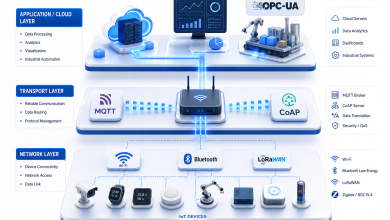
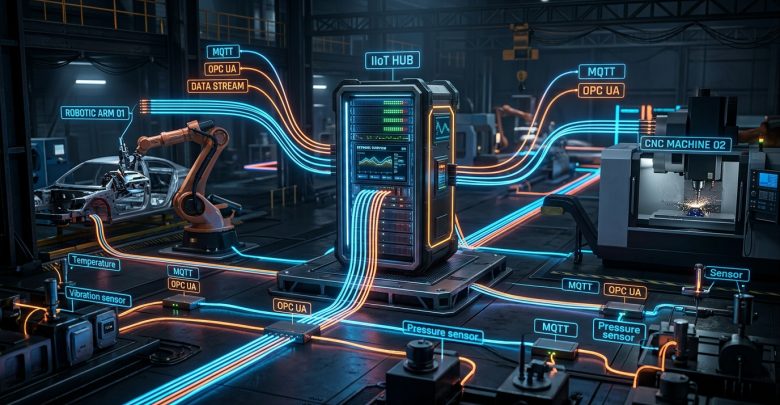
Most modern IIoT architectures use a hybrid approach: OPC UA at the machine level to standardize data, and MQTT to transport that data across the network to the cloud.
Tags: #IIoT #Industry40 #MQTT #OPCUA #Automation #SmartFactory #IndustrialEngineering #Connectivity