


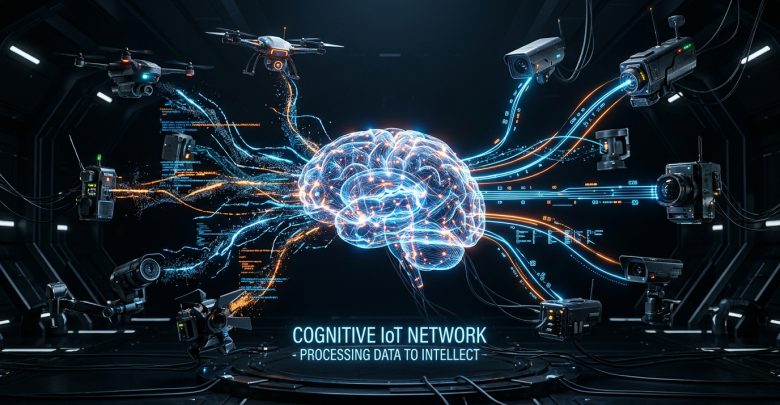
We live in an era where data is being generated at an exponential rate. While much of the buzz surrounds the sheer volume of “Big Data,” the true transformation lies in how we interpret and act upon it. The bridge between raw IoT sensor data and autonomous action is Machine Learning (ML).
What is Machine Learning (ML)?
At its core, Machine Learning is about minimizing human intervention. Instead of humans manually writing code for every possible scenario, ML allows systems to identify patterns within data and make autonomous decisions.
A simple, relatable example is the Siri virtual assistant. The more you interact with it, the better it understands your voice, preferences, and context—improving its accuracy over time without explicit manual reprogramming.
Why IoT Needs Machine Learning
IoT devices generate a relentless stream of data. Relying on human analysts to categorize, review, and send instructions back to these devices is not only inefficient; it is physically impossible as the network scales.
- The Speed of Decision-Making: Consider autonomous vehicles. They must process complex environmental data in milliseconds to avoid accidents. Human intervention in these decisions is impossible; the car must “learn” and decide on its own.
- Managing Scale: In industrial IoT, where thousands of sensors monitor machinery, ML serves as the “brain” that filters noise, detects anomalies, and optimizes performance in real-time.
Selecting the Right ML Algorithm
To implement ML effectively in an IoT ecosystem, developers must first define the specific objective. Algorithms are chosen based on the task:
1. Data Structuring & Grouping
When dealing with massive, unstructured datasets, Clustering algorithms are essential.
- K-means: This is the gold standard for grouping massive datasets, helping identify hidden structures or segments within seemingly chaotic data.
2. Anomaly Detection
IoT sensors often generate “noisy” data or outliers that could signal a hardware failure or a security threat.
- One-Class Support Vector Machines (SVM): Highly effective at identifying data points that deviate from the “normal” behavior of a system.
- PCA-Based Anomaly Detection: Uses Principal Component Analysis to reduce data complexity and pinpoint anomalies in high-noise environments.
3. Predictive Tasks
Other critical tasks include:
- Predicting Categories: Classifying incoming data into specific groups.
- Predicting Values: Forecasting future trends or measurements based on historical sensor data.
Conclusion: The Path to Autonomy
Integrating Machine Learning with IoT transforms “connected devices” into “smart agents.” By automating the analysis of data, ML empowers IoT to go beyond simple remote control and into the realm of proactive, autonomous operation.
As we continue to build a more connected world, the ability to select the right algorithm—whether it is for clustering, anomaly detection, or predictive analysis—will be the defining factor in how efficiently and securely our smart environments operate.
Tags:
#MachineLearning #IoT #ArtificialIntelligence #DataScience #SmartSystems #Automation #PredictiveAnalytics #KMeans #AnomalyDetection #FutureTech