

Smart Agriculture vs. Modern Farming: How IoT is Revolutionizing the Future of Agriculture

Over time, aging demographics and a shrinking younger workforce have led to an increase in the average age of farmers worldwide. To bridge this gap, machinery like automated milking systems and driverless tractors were invented, making heavy tasks easier and marking the birth of modern farming.
However, modern machines alone could not eliminate all manual decision-making and high operational costs. This limitation paved the way for the next evolution: Smart Agriculture.
The Difference Between Modern Farming and Smart Agriculture
While modern farming introduced mechanical tools to simplify labor, those traditional machines lacked sensors, data collection capabilities, and cloud connectivity.
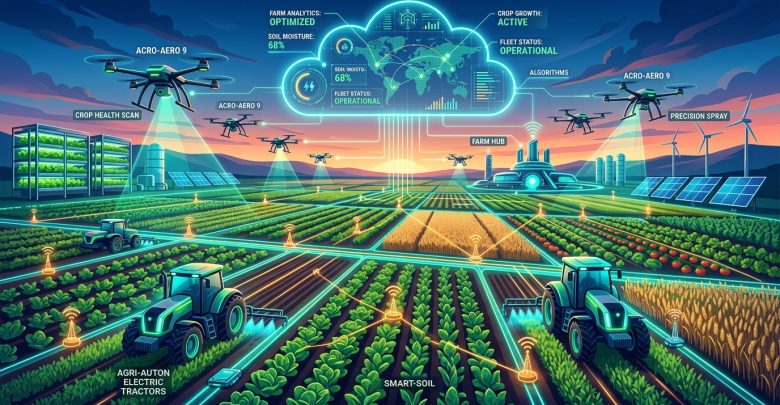
Smart Agriculture, powered by the Internet of Things (IoT), bridges this gap. Smart farming utilizes connected sensor networks to collect real-time data from the field, transmit it to cloud servers for instant analysis, and automatically trigger optimal responses or control actions. Farmers no longer just operate machinery—they manage automated, data-driven ecosystems.
Core Sensors in Smart Agriculture Systems
To achieve maximum yield and efficiency, smart farming relies on foundational sensor networks:
- Smart Soil Sensors: Measure critical parameters such as soil moisture, temperature, and nutrient levels.
- Smart Weather/Air Sensors: Monitor ambient temperature, humidity, and forecast weather shifts to protect crops.
- Smart Water Sensors: Track water quality metrics, such as pH levels, directly impacting plant health.
Collected data is sent to the cloud every 5 to 15 minutes, allowing processing systems to synchronize instantly with changing environmental conditions.
Key Benefits of Smart Agriculture
Although the initial implementation cost can be high, smart agricultural systems yield massive long-term returns:
- Precision & Quality Control: Drastically reduces human error, optimizes crop growing conditions, and maximizes overall harvest quality.
- Time Savings & Remote Control: Automates over half of a farmer’s daily tasks. Through remote dashboards, a farmer can open greenhouse windows or adjust irrigation with a single tap, without needing to physically travel to the field.
The Smart Agriculture Technology Stack
Smart farming integrates cutting-edge technologies to optimize both output and labor:
- Sensors: Soil, water, light, humidity, and temperature monitoring.
- Software: Specialized farm management software and IoT platforms.
- Connectivity: Mobile networks, LoRa, and wireless protocols.
- Location Systems: GPS and satellite mapping.
- Robotics: Autonomous tractors and smart harvesting machines.
- Data Analytics: Deep processing tools for predictive insights.
The IoT Smart Agriculture Cycle
To maintain real-time responsiveness, IoT-driven farming follows a continuous loop:
- Observation: Sensors continuously track crops, livestock, soil, and environmental metrics.
- Detection: Data is streamed to an IoT platform where predefined rules identify anomalies, stress factors, or resource deficits.
- Decision-Making: The system or user reviews the insights and initiates corrective actions (such as automated irrigation or adjusting greenhouse climates).
Major IoT Solutions in Agriculture
- Precision Farming: Tailors treatments (water, fertilizers, pest control) down to the exact square meter, moving away from uniform, blanket field management.
- Livestock Monitoring: Uses IoT tags and tracking applications to monitor the health, location, and well-being of farm animals, enabling early disease detection and preventing outbreaks.
Smart agriculture is no longer just a futuristic concept—it is the modern standard ensuring food security, sustainability, and efficiency for the future of farming.
#SmartAgriculture #IoT #PrecisionFarming #AgTech #SmartFarming #IoTInAgriculture #Automation #FutureOfFarming