
The Complete Guide to LoRaWAN Networks: Architecture, Classes, Security, and Data Rates

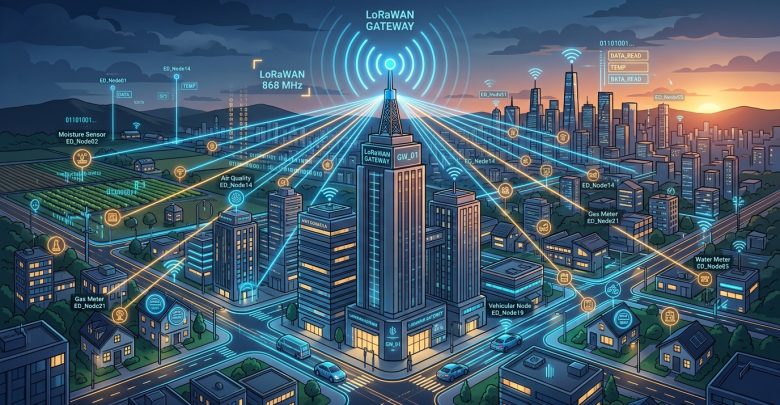
The LoRaWAN (Long Range Wide Area Network) protocol is a Low Power Wide Area (LPWA) networking standard specifically designed for wireless Internet of Things (IoT) devices. It operates seamlessly across regional, national, or global networks.
The core objectives of IoT in this framework include bidirectional communication, end-to-end security, mobility, and localization. In this architecture, final nodes (such as sensors or actuators) are referred to as End Devices, while intermediary relay devices are known as Gateways.
1. LoRaWAN Topology and Architecture
LoRaWAN networks use a Star Topology where gateways relay messages between end devices and a central network server.
- Gateways act as an invisible bridge, translating RF (Radio Frequency) packets into IP packets via standard IP connections (and vice versa).
- Wireless communications leverage the long-range capabilities of the LoRa physical layer, allowing single-hop links between an end device and one or more gateways.
- Support for multicast addressing groups enables efficient execution of tasks such as Firmware Over-The-Air (FOTA) updates or bulk messaging.
2. End-Device Classes
To balance power consumption, range, and application requirements, LoRaWAN categorizes end devices into three distinct classes:
- Class A (Lowest Power, Bidirectional – Default): Mandatory for all LoRaWAN devices. Communication is entirely asynchronous and always initiated by the end device. Any uplink transmission is followed by two short downlink receive windows. The device spends the majority of its time in a low-power sleep mode, allowing a single battery to last for several years.
- Class B (Deterministic Downlink Latency): In addition to Class A features, Class B devices synchronize with the network using periodic beacons, opening scheduled downlink ping slots. This provides bounded, predictable downlink latency (up to 128 seconds) while keeping energy overhead low enough for battery-powered operation.
- Class C (Lowest Latency): Class C minimizes downlink latency by keeping the end device’s receiver open continuously when it is not transmitting (half-duplex). The network server can initiate a downlink transmission at any time without delay. While drawing continuous power (up to 50mW), devices can dynamically switch between Class A and Class C for periodic tasks like remote firmware updates.
3. Data Rates and Network Optimization
Communication packets between end devices and gateways utilize variable Data Rates (DR). Selecting an appropriate DR dynamically balances communication range and message duration.
- The raw data rate in LoRaWAN ranges from 0.3 kbps to 50 kbps.
- To maximize battery lifespan and overall network capacity, the LoRaWAN network server individually manages the DR and RF output power for each end device using an algorithm called Adaptive Data Rate (ADR).
4. Security in LoRaWAN
Security is paramount in IoT deployments. LoRaWAN defines two layers of 128-bit encryption:
- Network Session Key: Ensures authenticity between the end device and the network server.
- Application Session Key (AppSKey): Provides end-to-end encryption managed directly at the application layer.
Keys can be provisioned via ABP (Activation by Personalization during manufacturing/setup) or OTAA (Over-The-Air Activation for secure dynamic key exchange). This dual-layer approach allows for multi-tenant shared networks without exposing user payload data to network operators.
5. Open Standards and Governance
The LoRaWAN specifications are maintained and driven by the LoRa Alliance. As an open standard, it empowers developers and industries to innovate, customize deployments (public, private, or enterprise), and ensure seamless interoperability across diverse hardware manufacturers.
#IoT #LoRaWAN #WirelessProtocols #EmbeddedSystems #SmartTech #NetworkProtocols