

1. Introduction: The High Stakes of Remote Firmware Deployment
There is no thrill quite like triggering an Over-The-Air (OTA) firmware update on hundreds of deployed IoT devices in the field.
When your hardware is sitting on a lab workbench connected via an FTDI serial programmer, an update failure is a minor inconvenience resolved with a quick cable swap. However, when your devices are mounted on remote industrial solar panels, embedded inside smart home appliances, or deployed across agricultural fields, a failed firmware update means dead hardware—and extremely expensive maintenance truck rolls.
📌 Engineering Insight: A single bricked device in production destroys end-user trust and incurs massive support costs. A bulletproof OTA architecture is not optional—it is a core requirement for production IoT fleet management.
2. The 3 Emotional Stages of an OTA Update
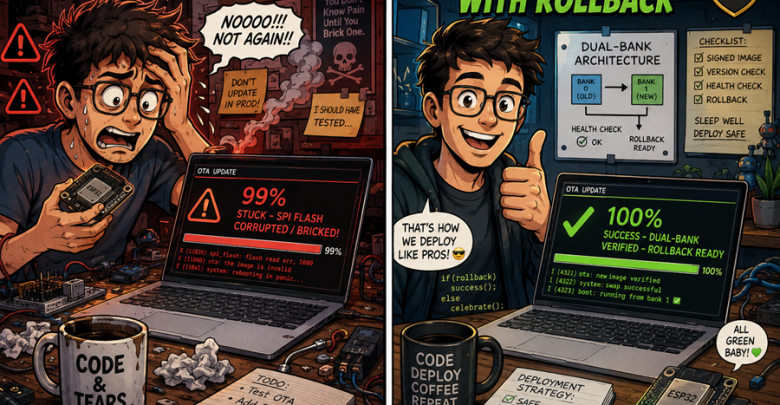
Every embedded software engineer who has pushed a remote update experiences these three distinct phases:
- False Confidence (0% Progress):The firmware passed all unit tests on your desk. The compiler generated a clean binary without warnings. You push the binary to your MQTT broker or OTA cloud server with complete peace of mind.
- The Panic Phase (99% Progress):The status LED stops blinking. Heartbeat telemetry messages disappear from your dashboard. Was the SPI Flash corrupted during a voltage brownout? Did the Wi-Fi connection drop mid-transfer? Is the device trapped in an endless boot loop?
- The Relief (100% Rebooted):The device re-establishes its TLS connection to the cloud broker, reports its updated firmware version, and responds to ping requests within 12ms. You survive another release cycle.
3. The 3 Pillars of a Bulletproof ESP32 OTA Architecture
To guarantee that an ESP32 microcontroller can never be bricked by a bad network connection, corrupt binary, or power interruption, your firmware must implement three critical safety pillars:
Pillar 1: Dual-Bank Partition Tables (ota_0 & ota_1)
Never overwrite running firmware directly. ESP32 partition tables should define two active factory app partitions: ota_0 and ota_1.
When the device runs on ota_0, the incoming firmware payload is written sequentially into ota_1. Only after full cryptographic verification is the ESP32 bootloader instructed to swap boot flags to point to ota_1. If the write operation breaks mid-way, the device simply reboots into the unmodified ota_0 partition.
Pillar 2: Cryptographic Signature Validation (Secure Boot)
Before flashing any incoming binary to SPI Flash, verify its RSA/ECDSA signature using hardware-enforced Secure Boot keys. This prevents malicious actors from hijacking your OTA channel and stops incomplete or corrupted binaries from ever reaching the execution stage.
Pillar 3: Automatic Rollback Mechanisms
Using ESP-IDF’s native esp_ota_mark_app_valid_cancel_rollback() API, the bootloader marks newly flashed firmware as “pending verification”.
Upon reboot, the new firmware must successfully connect to the MQTT broker, execute self-diagnostics, and explicitly mark itself as valid within a set timeout window (e.g., 30 seconds). If it crashes, panics, or fails to connect, the ESP32 hardware watchdog triggers a reset, and the bootloader automatically rolls back to the previous known-good partition.
4. Summary & Best Practices Checklist
| Feature | Basic OTA (Risky) | Production OTA (Bulletproof) |
| Storage Strategy | Overwriting active flash | Dual-Bank Partitions (ota_0 / ota_1) |
| Verification | Simple Checksum (CRC32) | Hardware RSA/ECDSA Signature |
| Failure Recovery | Manual Serial Re-flash | Automated Watchdog Rollback |
| Network Security | Plain HTTP Download | TLS 1.3 / Encrypted Payload |
5. Next Steps & Resources
Modern IoT platforms derive their greatest strength from Over-The-Air upgradability. By engineering fail-safe mechanisms directly into your partition tables and bootloaders, you transform OTA from a nerve-wracking risk into a reliable competitive advantage.
- 🎬 Watch the Tutorial: Step-by-step hands-on ESP32 OTA implementation videos are available on our official IoT Journal YouTube Channel.
- 💬 Join the Discussion: Have you ever bricked a fleet of devices remotely? Share your field stories and lessons learned in the comments below!