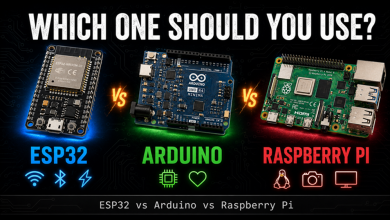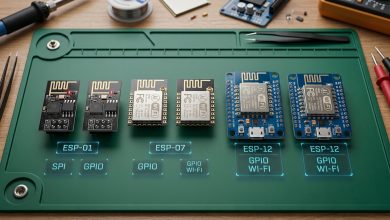


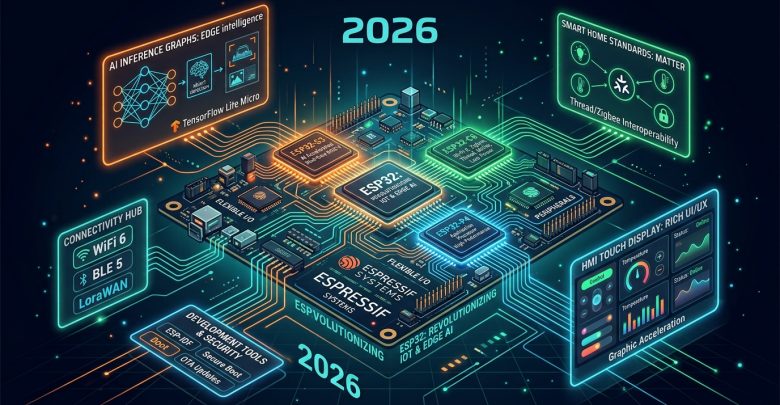
What started back in 2016 as a single dual-core chip with Wi-Fi and Bluetooth has evolved into a massive, sprawling silicon ecosystem. Today, “ESP32” is no longer just a single microcontroller—it is an entire product family spanning over a dozen System-on-Chips (SoCs).
Whether you are designing a low-power smart home sensor running on a coin cell battery, an edge-AI computer vision camera, or a high-performance industrial HMI touch display panel, there is an ESP32 engineered specifically for the job.
This comprehensive 2026 guide breaks down the entire Espressif ESP32 lineup, highlights the core differences between variants, and provides a clear framework to help you choose the right chip and board for your next IoT project.
1. Understanding the ESP32 Family Tree (The Branches)
To make sense of the modern ESP32 ecosystem, it helps to understand how Espressif organizes its architecture and naming conventions. The family generally splits into distinct series:
- The Original Classic Series: The legendary workhorse that started it all. Reliable, dual-core, and ubiquitous.
- The “S” Series (Specialized / High Performance): Built for heavier computational tasks, native USB OTG capabilities, human-machine interfaces (HMI), and Edge AI / Machine Learning acceleration.
- The “C” Series (Cost-Effective / RISC-V): Built around the open-source RISC-V architecture, focusing on high security, ultra-low cost, and modern wireless protocols like Wi-Fi 6 and Matter.
- The “H” Series (Short-Range Wireless Only): Tailored strictly for low-power mesh networks (Thread, Zigbee, BLE) without the power overhead of Wi-Fi.
- The “P” Series (High-Performance Multimedia Processors): Heavy-duty dual-core RISC-V processors built for advanced graphic displays and machine vision, operating without integrated wireless.
2. Head-to-Head Comparison: Major ESP32 Variants
| Variant | Core Architecture | Wireless Protocols | Best Suited For |
| ESP32 (Original) | Dual-core Xtensa (up to 240 MHz) | Wi-Fi 4, Bluetooth Classic & BLE | General-purpose IoT, classic projects, robust community support. |
| ESP32-S2 | Single-core Xtensa (240 MHz) | Wi-Fi only (No Bluetooth) + Native USB | USB-connected devices, low-power logging, secure tokens. |
| ESP32-S3 | Dual-core Xtensa + Vector Extensions (240 MHz) | Wi-Fi 4 + BLE 5.0 | Edge AI/ML inference, smart cameras, voice recognition, heavy GUI displays. |
| ESP32-C3 | Single-core RISC-V (160 MHz) | Wi-Fi 4 + BLE 5.0 | Cost-effective commercial sensors, secure boot applications. |
| ESP32-C5 / C6 | RISC-V (up to 160 MHz) | Wi-Fi 6, Thread, Zigbee, Matter, BLE | Next-gen Smart Home ecosystems, Matter-enabled edge nodes. |
| ESP32-H2 | Single-core RISC-V | Thread, Zigbee, BLE 5.4 (No Wi-Fi) | Ultra-low power sensor mesh networks. |
| ESP32-P4 | Dual-core RISC-V (400 MHz) | None (Requires companion wireless chip) | High-performance industrial HMI touch panels, multimedia processing. |
3. Deep Dive: Choosing the Right Chip by Use Case
Scenario A: You are building an Edge AI, Voice Assistant, or Smart Camera Project
- Your Go-To Chip: ESP32-S3
- Why: The S3 features dedicated vector instructions (SIMD) built into its dual Xtensa cores, supercharging neural network performance. Combined with extensive support for high-speed PSRAM (up to 8MB) and native camera/LCD interfaces, it is the undisputed king of microcontroller-based computer vision and offline voice command systems.
Scenario B: You are designing Smart Home / Matter-Compliant Devices
- Your Go-To Chip: ESP32-C6 (or ESP32-C5 for dual-band 5 GHz support)
- Why: Modern smart homes rely heavily on Matter, Thread, and Zigbee protocol interoperability. The C6 brings power-efficient Wi-Fi 6 alongside an 802.15.4 radio, allowing your device to communicate natively across thread meshes while remaining remarkably energy-efficient.
Scenario C: You need a High-End Industrial Display (HMI)
- Your Go-To Chip: ESP32-P4
- Why: Running at a blazing 400 MHz with advanced hardware image signal processing (ISP) and H.264 video encoding, the P4 handles gorgeous multi-inch touch capacitive displays with ease. Note: Because it lacks onboard wireless, it is usually paired with an ESP32-C6 companion chip if network access is required.
Scenario D: General DIY, Legacy Projects, and Prototyping
- Your Go-To Chip: ESP32 (Original) or ESP32-C3
- Why: If you just want something that “just works” with thousands of existing Arduino tutorials, open-source libraries, and classic Bluetooth support, the original ESP32 remains a safe bet. For streamlined, low-cost commercial products that only need basic Wi-Fi and Bluetooth LE, the RISC-V-based ESP32-C3 provides a cheaper, highly secure modern alternative.
4. Common Pitfalls to Avoid When Buying an ESP32 Board
- Ignoring Memory Limitations (Flash & PSRAM): Many cheap base-model boards (like basic ESP32-C3 or base ESP32 modules) come with zero PSRAM and minimal flash. If your code involves heavy JSON parsing, web servers, or image buffering, you will run out of heap memory. Always check if the module includes external PSRAM if your project is data-heavy.
- Confusing Wireless Protocols: Assuming “every ESP32 has Wi-Fi and Bluetooth.” Chips like the ESP32-S2 lack Bluetooth entirely, while the ESP32-H2 features zero Wi-Fi capabilities and relies entirely on Thread/Zigbee. Read the spec sheet carefully before ordering.
- Overlooking Power Consumption Profiles: Dual-core Xtensa chips draw significantly more power at peak load than single-core RISC-V variants (like the C-series or H-series). If you are building a battery-operated remote sensor running on a small LiPo or solar cell, opt for the low-power consumption architectures of the C or H series.
5. Summary / Final Recommendation
- Choose the ESP32-S3 for machine learning, cameras, and rich user interfaces.
- Choose the ESP32-C6 for future-proof smart home IoT and Wi-Fi 6/Matter integrations.
- Choose the ESP32-P4 for high-end industrial automation screens and heavy graphics.
- Choose the Original ESP32 or ESP32-C3 for everyday budget sensors and general prototyping.
Sources & Further Reading
- Official Technical Documentation: Espressif Systems Official Documentation & Technical Reference
- Architecture & Repository Hub: Espressif GitHub Organization & Hardware Guides
#ESP32 #Espressif #EmbeddedSystems #IoT #Microcontrollers #SmartHome #EdgeAI #RISC_V #TechGuide2026