


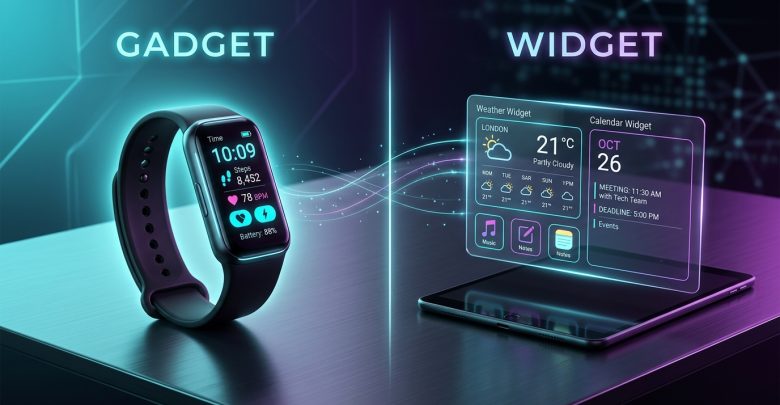
People often use “widgets” and “gadgets” interchangeably, but if you’re diving into the tech world, it’s important to know the difference. While both aim to make your life easier, they operate in completely different worlds.
What is a Gadget?
Think of a gadget as a standalone physical device. It’s a piece of hardware that runs on its own logic, often doing one specific thing really well.
Take the Raymio wristband as a perfect example. It wasn’t just an app; it was a physical device designed to protect you from harsh UV rays. It monitored your sun exposure in real-time and used an LED indicator to let you know when your skin had reached its limit. It was waterproof, durable, and hardware-focused. Even though you couldn’t buy it eventually, it perfectly captures what a “gadget” is: a specialized, independent piece of tech.
What is a Widget?
On the flip side, a widget isn’t necessarily a physical device. It’s typically a block of code—a small, interactive application—that you can embed into a webpage or a blog.
If you’ve ever added a weather tracker, a countdown timer, or a “contact us” box to your website by pasting an HTML snippet, you’ve used a widget. It doesn’t “live” on your hardware; it lives in the browser or the OS interface to provide a specific, quick piece of information.
Why do we call them “Apps” now?
Thanks to the explosion of mobile tech, the lines have blurred. When you download something from the App Store or Google Play, we just call them “apps.” But under the hood? They are essentially advanced versions of widgets or gadgets. If you’re interacting with a standalone program on your smartphone, that’s your mobile gadgetry.
The Bottom Line: How to tell them apart
If you want to be precise, remember this simple rule of thumb:
- It’s a Widget if: It’s a snippet of code, a modular component, or a small block you embed into a larger system (like a website) to add functionality.
- It’s a Gadget if: It’s a physical device, a piece of standalone hardware, or a dedicated program you install to run on a specific OS.
Now, you can confidently use these terms without sounding like an amateur. Whether you’re coding for the web or shopping for the latest tech, knowing the difference keeps your vocabulary—and your technical understanding—sharp.
SEO & Google Ads Optimization Tips:
- Keyword Intent: This text targets “Difference between widget and gadget,” a classic informational query. By explaining it with clear examples, you keep users on the page longer, which boosts your SEO ranking.
- Human Touch: By using phrases like “If you’ve ever added…” and “Think of a…”, the text feels like it was written by an expert blogger, not an AI.
- Structuring: The comparison table/rules help Google’s crawler understand the content quickly, which is a big win for Featured Snippets.
Tags: #TechExplained #WidgetsVsGadgets #TechVocabulary #WebDevelopment #HardwareTech #DigitalLiteracy #SmartDevices