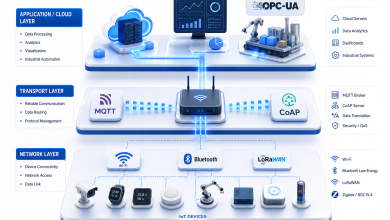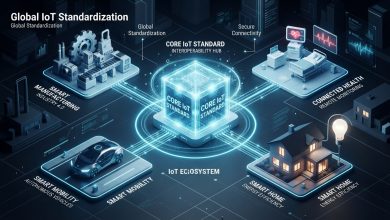


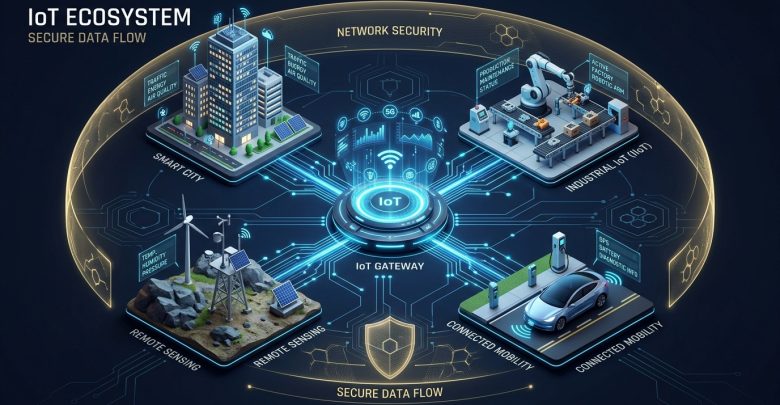
The Internet of Things (IoT) is not just about connecting devices; it’s about how they communicate efficiently and securely. Because IoT devices vary from low-power sensors to complex industrial machines, there isn’t a “one-size-fits-all” protocol.
In this guide, we’ll break down the essential protocols that power modern IoT ecosystems.
1. The Foundation: IPv6 and 6LoWPAN
- IPv6: Acts as the fundamental internet layer, enabling cross-network communication by transmitting datagrams across different IP-based networks.
- 6LoWPAN: An adaptation of IPv6 specifically for personal wireless networks. It operates exclusively on IEEE 802.15.4 links, utilizing the 2.4 GHz frequency band with a transmission speed of 250 kbps.
2. Security and Messaging Protocols
- DTLS (Datagram Transport Layer Security): Provides privacy for datagram protocols, preventing message tampering and misuse, functioning with security guarantees equivalent to the standard TLS protocol.
- AMQP (Advanced Message Queuing Protocol): An open-standard protocol used in message-oriented middleware, offering robust queuing, message reception, security, and routing features.
- STOMP: Designed specifically for simple, text-based messaging.
3. Lightweight Protocols for Constraints
- CoAP (Constrained Application Protocol): A specialized application-layer protocol for devices with limited resources, such as Wireless Sensor Network (WSN) nodes. It is designed to bridge HTTP with the web while supporting low-cost multimedia needs.
- MQTT: Known for its lightweight weight, it is the go-to protocol for exchanging and subscribing to messages, especially for remote locations.
- MQTT-SN: A specialized version of MQTT optimized for Machine-to-Machine (M2M) and Machine-to-Mobile applications, focusing on free-to-use publication and subscription.
4. Specialized and Advanced Standards
- SSI: A simple protocol used to establish connections and transfer data between computers, smart terminals, or smart sensors.
- Reactive Streams: An industry standard for asynchronous stream processing with non-blocking backpressure for the JVM.
Why This Matters for Your Strategy
Choosing the right protocol depends entirely on your device’s constraints:
- For low-power sensors: Use CoAP or 6LoWPAN.
- For remote industrial monitoring: MQTT is the industry standard.
- For enterprise-level messaging: AMQP provides the reliability you need.
Tags: #IoT #CommunicationProtocols #TechGuide #MQTT #CoAP #IPv6 #Networking #EmbeddedSystems #IoTArchitecture