
Sensor Noise vs Algorithm Error: How to Calibrate IoT Sensors Correctly

Introduction
One of the hardest parts of building IoT products is guaranteeing sensor data accuracy. When a wrong number comes out of a sensor, the question always comes up: is this the sensor’s fault, or the algorithm processing the data? This article covers how to tell these apart, and how to calibrate correctly.
Where Sensor Noise Actually Comes From
Sensor noise can originate from several sources:
- Thermal noise in analog circuits
- Electromagnetic interference (EMI) from other components on the board
- Factory miscalibration
- Natural drift over time or with temperature changes
Why Software Filters Aren’t Always the Answer
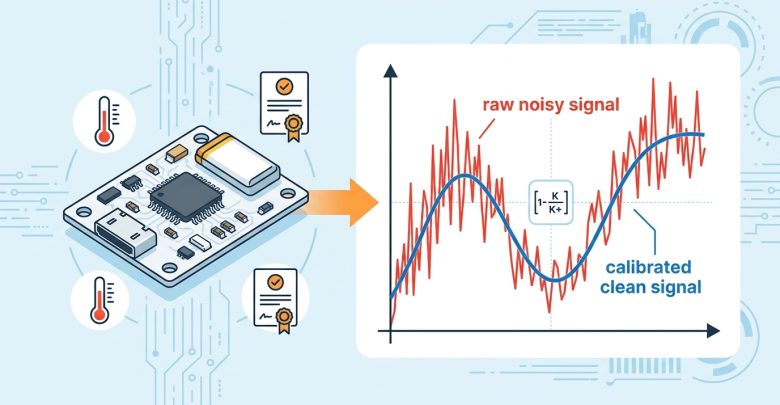
Many teams assume a Kalman filter or moving average can fix any data problem. But if the raw data is flawed from the start (say, due to miscalibration), the filter just makes the noise look “smoother” — not more accurate.
How to Diagnose: Hardware Noise or Algorithm Error?
Step 1: Log Raw Data Before Any Filtering
Always log the raw, unfiltered signal before applying any algorithm. This is the only way to later figure out where a problem actually started.
Step 2: Compare Against a Reference Sensor
Use a properly calibrated, high-accuracy reference instrument (like a lab-grade tool) and compare your sensor’s output against it.
Step 3: Check the Datasheet’s Actual Tolerance
Engineers often assume a sensor has near-infinite accuracy, when the datasheet clearly states a specific tolerance (e.g., ±2°C).
Step 4: Test Across Real-World Temperature/Environmental Ranges
Sensors that perform great at room temperature can behave completely differently at high temperatures or high humidity.
Practical Calibration Techniques
- Two-Point Calibration — measure at two known values and calculate offset and gain.
- Temperature Compensation Table — store correction coefficients for different temperatures.
- Simple Kalman Filter to reduce random noise without destroying the real signal.
- Adaptive Thresholding instead of fixed, hardcoded values.
Conclusion
Before writing a complex filtering algorithm, always check the raw data and compare it against a reference. Many “algorithm bugs” are actually hardware calibration problems that a software filter simply hides — it doesn’t fix them.
FAQ
When is a Kalman filter the best choice? When you have random noise and want a more stable estimate of the true signal; it’s less effective against systematic drift.
How do I know if my sensor is drifting? By periodically comparing the sensor’s output against a calibrated reference over time (e.g., monthly) and tracking the trend.
Can calibration be done entirely in software? Partially, yes — but you still need at least one accurate physical reference to determine the initial offset and gain.
Hashtags
#IoT #Sensors #SignalProcessing #EmbeddedSystems #KalmanFilter #DataEngineering #IoTJournal