

Radio Frequency Identification, commonly known as RFID, is a powerful wireless communication technology used to automatically identify, track, and manage objects, animals, or people. Often regarded as the smart, next-generation evolution of traditional barcodes, RFID’s greatest advantage is that it does not require a direct line of sight to scan and identify items.
1. How an RFID System Works
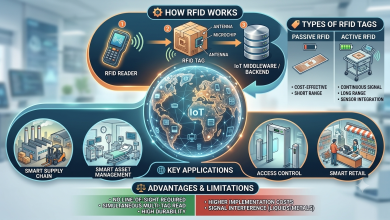
A standard RFID setup consists of two primary components:
- RFID Tags: Built with a microchip, internal memory, and an antenna, these tags store unique identification data (like serial numbers). They can be read-only or read-write capable.
- RFID Readers: Fixed or portable devices equipped with antennas that emit radio frequency waves. These waves activate the tags, prompting them to transmit their stored data back to the reader.
2. Types of RFID Tags (Based on Power Source)
- Active Tags: Equipped with an internal power source (battery), enabling much longer read ranges and robust broadcasting capabilities.
- Passive Tags: Lacking a battery entirely, these tags harvest their required electrical energy directly from the electromagnetic waves emitted by the reader’s antenna.
- Semi-Active Tags: Utilize both a battery (to power internal microchip circuits) and the reader’s signal, typically supporting up to 2 KB of data storage.
3. RFID Frequency Bands
- Low Frequency (LF – 30 kHz to 500 kHz): Typically operates around 125 kHz with a short read range (from a few centimeters up to 1.8 meters).
- High Frequency (HF – 3 MHz to 30 MHz): Typically operates at 13.56 MHz, covering distances from centimeters to several meters (widely used in smart cards and contactless payments).
- Ultra-High Frequency (UHF – 300 MHz to 960 MHz): Can be read from distances of 8 meters or more (and up to 100 meters with high-powered active tags).
4. RFID vs. Traditional Barcodes
| Feature | RFID Technology | Traditional Barcodes |
|---|---|---|
| Line of Sight | Not required | Required (must face the scanner directly) |
| Batch/Group Scanning | Scans thousands of tags simultaneously in under 100 ms | Scanned individually (one item at a time) |
| Data Reusability | Yes (rewritable data capability) | No (static and printed) |
| Physical Durability | High (tags are sealed in protective enclosures) | Vulnerable (easy to tear, smudge, or scratch) |
| Implementation Cost | Higher | Very low |
5. Key Applications of RFID
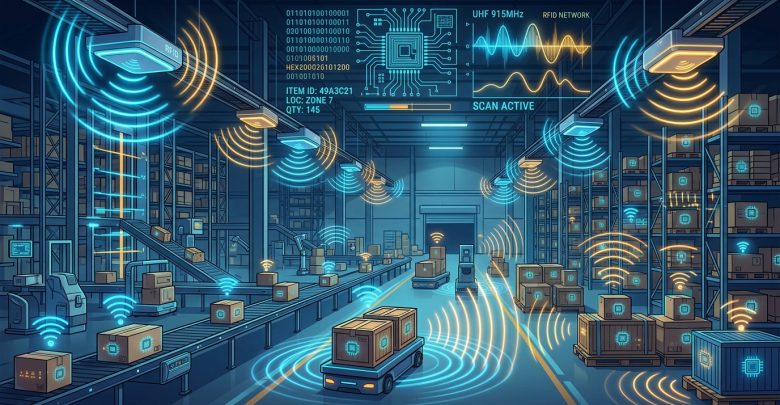
- Inventory & Retail Management: Streamlining warehouse logistics and enabling lightning-fast checkout experiences where entire shopping carts are scanned simultaneously without unpacking items.
- Supply Chain & Logistics: Automated tracking of cargo, fleet management, and electronic toll collection on highways.
- Agriculture & Livestock: Monitoring the location, health, and status of livestock herds without physical contact.
- Secure Access & Documents: Embedded secure chips in modern passports (utilizing advanced protocols like BAC) for reliable identity verification.
6. Security, Standards, and the Future
- Security & Privacy: Basic RFID tags lack high processing power and cannot be heavily encrypted, making them readable by any compatible scanner. However, high-security sectors utilize advanced chips with protocols like BAC.
- Global Standards: Governed by prominent bodies through standards such as ISO (e.g., ISO 14223 for LF, ISO 15693 for HF, and ISO 18000-6C for UHF), EPCglobal, and IEC.
- The Next Generation: The future of RFID lies in integrating smart sensors, allowing wireless transmission of environmental data—such as temperature, motion, and exact location—alongside standard identification markers.
#RFID #WirelessTechnology #InternetOfThings #SupplyChain #Automation #SmartTracking #TechStandards