

In the world of IoT, we are dealing with devices that lack the memory, processing power, and energy reserves to run heavy web protocols like HTTP/HTTPS. To bridge this gap, two major protocols have emerged: MQTT and CoAP.
Why Not Use Standard Web Protocols?
Most IoT devices (like smart bulbs or environmental sensors) are resource-constrained. They cannot handle the overhead of complex TCP/IP handshakes or the heavy parsing of massive HTTP payloads. We need lightweight, efficient alternatives.
Understanding CoAP (Constrained Application Protocol)
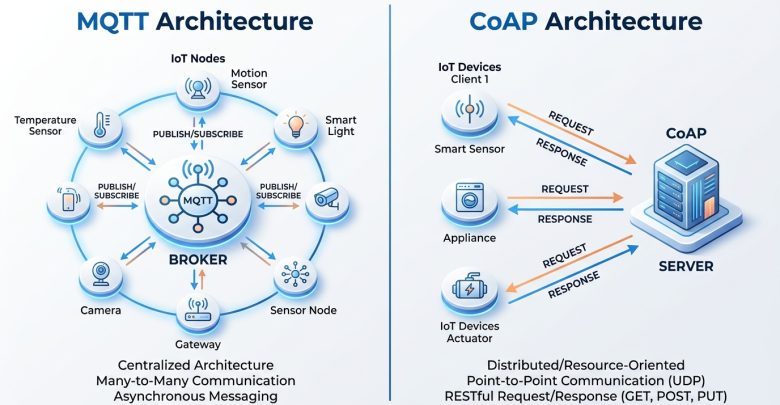
CoAP is designed for M2M (Machine-to-Machine) communication. It brings the power of RESTful APIs—the foundation of the web—to the world of low-power devices.
- RESTful Core: It uses standard methods:
GET(read),POST(create),PUT(update), andDELETE(remove). - Transport Layer: It operates over UDP, making it faster and lighter than TCP-based protocols.
- Ideal Use Case: Client-Server architectures where the communication path to the server is stable.
Comparative Analysis: CoAP vs. MQTT
| Feature | MQTT | CoAP |
| Model | Publish/Subscribe | Request/Response (REST) |
| Transport | TCP | UDP |
| Architecture | Broker-centric | Client-Server / Peer-to-Peer |
| Security | SSL/TLS | DTLS |
| Best For | Unstable networks, low power | Stable networks, data manipulation |
Which One Should You Choose?
Choose MQTT if:
- Connectivity is Unreliable: If your devices frequently drop off the network, the “Broker” approach ensures messages are queued until the device reconnects.
- Energy Efficiency is Paramount: Since the client only sends data to the broker, the device can spend more time in “Deep Sleep.”
- Network Stability is Low: TCP provides a reliable, ordered delivery of messages.
Choose CoAP if:
- Client-Server is your Architecture: If your system functions like a traditional web service where you need to modify or query state.
- Network is Reliable: Since it uses UDP, it is less “forgiving” of packet loss than TCP.
- You Need Resource Manipulation: If you need the ability to CRUD (Create, Read, Update, Delete) resources on a remote device directly.
Conclusion: It’s All About the Context
While MQTT is currently more popular in the market due to its robust ecosystem and reliability in unstable networks, CoAP remains the superior choice for architectures that need to integrate seamlessly with web-based standards (RESTful). Neither is “better”; the right choice depends on whether your priority is robust messaging (MQTT) or resource management (CoAP).
Tags: #IoT #CoAP #MQTT #Networking #EmbeddedSystems #MachineToMachine #TechComparison