
From Prototype to Mass Production: Why Your Hardware Product Fails at Scale

Understand why hardware that works perfectly as a prototype often fails in mass production, and learn the Design for Manufacturing (DFM) practices that prevent it.
Introduction
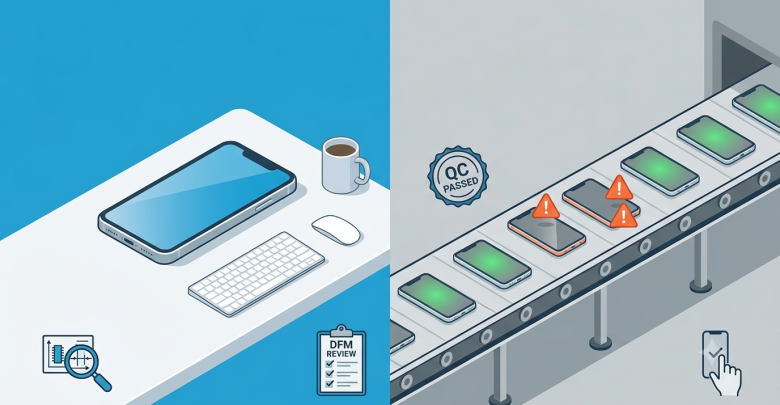
Many hardware startups run into a harsh reality: a prototype that’s worked flawlessly for months suddenly shows an unacceptable failure rate in mass production. This gap between “working on the engineering bench” and “working at a scale of thousands of units” is one of the hardest stages of hardware product development.
Why One Working Unit Doesn’t Guarantee Thousands Will Work
- Component tolerance — a resistor or capacitor with 5% tolerance might have no effect on a single unit, but combined with several other components with similar tolerances, it can shift circuit behavior in some units.
- Supplier batch variation — parts from two different production batches, even with the same part number, can have slightly different characteristics.
- Assembly process differences — hand-soldering a single prototype versus automated SMT assembly on a production line produces different results.
- Insufficient quality control during functional testing on the production line.
The Right Process for Moving from Prototype to Production
Step 1: Conduct a DFM (Design for Manufacturing) Review Before Tooling
Before ordering final molds or PCBs, the design team should review the product from the perspective of “is this actually manufacturable at scale?” — not just “does it work?”
Step 2: Test With Multiple Component Batches From Different Suppliers
Before committing to a single supplier, test the design with at least 2–3 different batches to identify sensitivity to tolerance variation.
Step 3: Run a Small Pilot Production Batch
Before full production, build a test batch (e.g., 50–100 units) and measure the failure rate. If it’s above 1–2%, the issue needs to be resolved before full-scale production.
Step 4: Define End-of-Line (EOL) Tests
Every unit should pass an automated functional test (voltage check, communication test, basic calibration) before leaving the production line.
Best Practices for Reducing Failure Rates at Scale
- Design with margin — instead of designing exactly at the spec boundary, leave a safety margin for component variation.
- Fully document the BOM with approved alternates to avoid production stoppages when a specific part becomes unavailable.
- Work closely with your contract manufacturer from the early design stages, not just at the end.
- Perform failure analysis on every defective unit in the pilot run to identify common patterns.
Conclusion
A successful transition from prototype to mass production requires accepting that “one unit working” guarantees nothing at scale. Teams that take DFM and pilot runs seriously reduce the risk of expensive product recalls or production line stoppages down the road.
FAQ
What is DFM and why does it matter? Design for Manufacturing is the process of reviewing a product’s design from the perspective of manufacturability at scale, including cost, assembly speed, and sensitivity to component tolerance.
What’s a reasonable size for a pilot run? Usually between 50 and 200 units, depending on product complexity, is enough to surface common production issues before committing to full-scale manufacturing.
How do you determine an acceptable failure rate? This depends on the industry and product use case, but for most consumer IoT products, a failure rate below 1% at EOL testing is a reasonable target.
Hashtags
#IoT #HardwareEngineering #Manufacturing #DFM #ProductDevelopment #IoTJournal