
Why Does My IoT Device’s Battery Drain So Fast? Low Power Design Guide

Introduction
One of the most common complaints in battery-powered IoT projects is: “The design said two years, but the battery died in two weeks!” This gap between theory and reality is usually rooted in a combination of hardware decisions and firmware behavior.
Why Theoretical Battery Life Calculations Are Often Wrong
Initial calculations are usually based on the MCU’s datasheet sleep-state current, without accounting for:
- Power draw from peripherals (sensors, radio modules) that may stay awake
- Leakage current in low-quality voltage regulator circuits
- The actual number of daily wake-up cycles, which is often higher than assumed
How to Diagnose the Root Cause of Battery Drain
Step 1: Profile Current with a Proper Tool
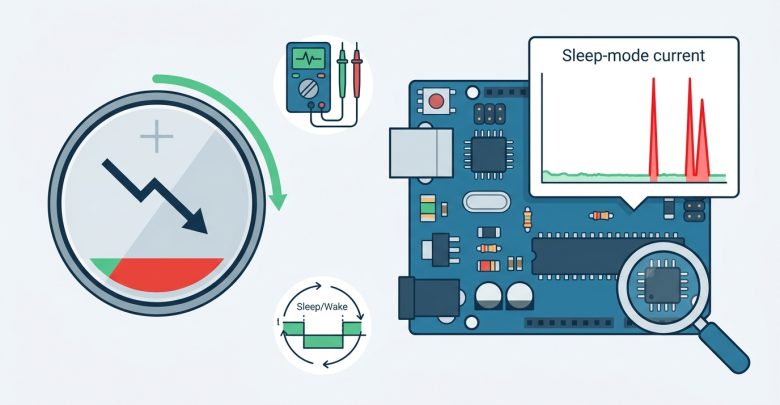
Use a power profiler (like the Nordic Power Profiler Kit or Otii) to see a precise current graph over time, instead of relying on a regular multimeter that can’t capture fast transients.
Step 2: Test Each Peripheral Individually
Turn each sensor, WiFi/BLE module, and LED on and off individually and observe how total consumption changes. Often one forgotten sensor is left “on.”
Step 3: Measure Actual Time Spent in Deep Sleep
Using a stopwatch or logger, measure the real time spent in deep sleep and compare it against the expected value.
Step 4: Check the Power Supply Circuit for Leakage
Sometimes the voltage regulator itself, or peripheral circuits (like a permanently-on power indicator LED), draw noticeable current even in idle state.
Best Practices for Low-Power Design
- Choose an MCU with multiple sleep tiers (like STM32 Low-Power modes or nRF52 System OFF).
- Fully cut power to unnecessary peripherals using a switching transistor instead of just disabling them in software.
- Reduce transmission frequency — sometimes sending data every 5 minutes instead of every 30 seconds multiplies battery life several times over.
- Use an LDO with low quiescent current instead of a standard regulator.
- Run long-term field tests before making any battery life claims in the final product.
Conclusion
Battery consumption in IoT is always the result of hardware and firmware working together. Without precise current profiling, any battery life claim is really just a guess — not engineering.
FAQ
What’s the best tool for measuring IoT current consumption? Tools like the Nordic Power Profiler Kit II or Qoitech Otii are industry standard because they can capture fast current fluctuations at the microsecond level.
Is deep sleep always the best mode? It depends. If the device needs a fast response time, intermediate modes (like Stop Mode) may offer a better balance between power savings and response time.
Why does the battery still drain fast even with deep sleep enabled? Usually because peripherals aren’t fully powered down, or there’s leakage current in the power supply circuit.
Hashtags
#IoT #LowPower #EmbeddedSystems #BatteryLife #Firmware #HardwareDesign #IoTJournal