
JavaScript for IoT: Empowering Connected Devices and Smart Ecosystems

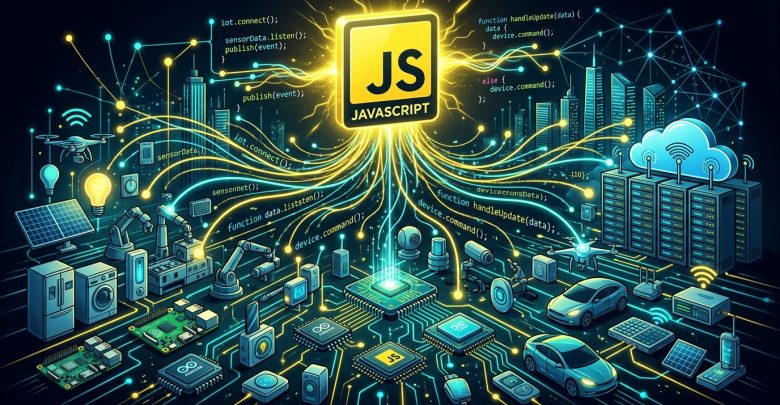
As the Internet of Things (IoT) continues to reshape industries, smart homes, and industrial automation, developers are constantly looking for flexible, efficient, and widely adopted programming languages to build connected solutions. While languages like C, C++, and Python have long dominated embedded systems, JavaScript has rapidly emerged as a powerful contender in the IoT landscape.
By bringing the world’s most popular web language to hardware and edge devices, JavaScript enables full-stack developers to build end-to-end IoT applications using a single language from the sensor to the cloud.
Why JavaScript for IoT?
Traditionally, microcontrollers and low-level hardware required compiled languages to manage constrained resources. However, modern advancements in JavaScript engines (such as Google’s V8) and lightweight runtimes have made it entirely feasible to run JavaScript on resource-constrained devices.
Key advantages of using JavaScript for IoT include:
- Full-Stack Uniformity: Developers can use JavaScript/Node.js for both backend cloud services and frontend dashboards, as well as on the physical device itself. This drastically reduces the learning curve and speeds up development time.
- Asynchronous Event-Driven Architecture: IoT applications rely heavily on handling asynchronous events—such as sensor readings, network requests, and incoming user commands. JavaScript’s non-blocking I/O model makes it naturally suited for managing multiple real-time data streams simultaneously.
- Massive Ecosystem and Package Management: With npm (Node Package Manager), developers gain instant access to hundreds of thousands of reusable libraries, greatly accelerating IoT prototyping and integration.
Key Frameworks and Runtimes for JavaScript in IoT
Several specialized tools and runtimes allow JavaScript to interact directly with hardware components and communicate across IoT networks:
1. Node.js
While primarily known for server-side development, Node.js serves as a core backend engine for IoT gateways and cloud platforms. It excels at aggregating massive amounts of telemetry data from thousands of connected sensors, processing it, and routing it to databases or dashboards in real time.
2. Johnny-Five
Developed by Bocoup, Johnny-Five is the leading JavaScript robotics and IoT programming framework. It provides a robust, extensible API that runs on Node.js, allowing developers to control hardware devices (like Arduino, Raspberry Pi, and other microcontroller boards) using simple JavaScript code.
3. Espruino
For ultra-constrained microcontrollers that cannot run full Node.js, Espruino is an ingenious solution. It is an extremely lightweight JavaScript interpreter designed specifically for microcontrollers. It allows developers to write and debug JavaScript directly on tiny chips with minimal memory footprint.
Typical Use Cases of JavaScript in IoT
- Smart Home Automation Dashboards: Building real-time web interfaces using Node.js to monitor and control smart lighting, thermostats, and security cameras.
- Industrial IoT Gateways: Acting as a bridge between localized sensor networks (communicating via MQTT or HTTP) and enterprise cloud servers.
- Prototyping and Rapid MVPs: Enabling web developers to transition smoothly into hardware prototyping without needing to master low-level C programming.
Conclusion
JavaScript has broken through the boundaries of web browsers, establishing itself as a viable and highly efficient tool for the Internet of Things. Whether you are building smart city infrastructure, home automation systems, or cloud-connected wearables, JavaScript provides the speed, flexibility, and ecosystem support needed to bring modern IoT ideas to life.
#IoT #JavaScript #NodeJS #JohnnyFive #Espruino #SmartHome #FullStack #WebDevelopment #TechInnovation