
The Ultimate Guide to ZigBee Technology: Architecture, Security, and Applications

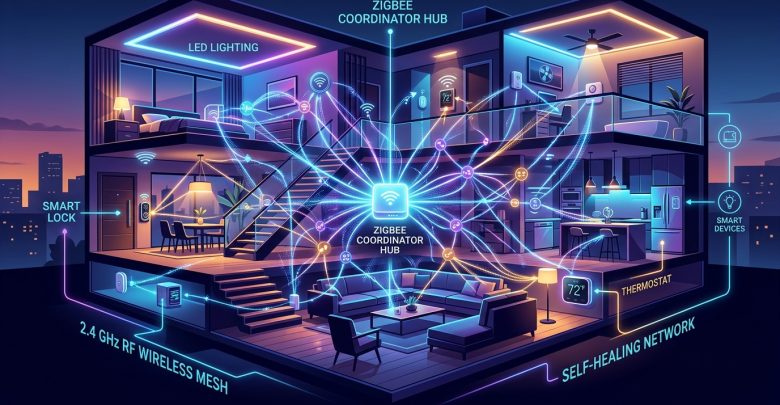
ZigBee is a low-power, low-cost wireless mesh networking standard built upon the IEEE 802.15.4 physical and MAC layers. Designed specifically for low-bandwidth, small-scale personal area networks (WPANs), it is widely utilized in home automation, smart lighting, medical data collection, and industrial monitoring.
1. Core Concept and Technical Specifications
The primary goal of ZigBee is to provide a simpler and significantly cheaper alternative to other WPAN technologies like Wi-Fi or Bluetooth, especially for devices requiring long battery life and secure, intermittent data transmission.
- Frequency Bands & Data Rates: ZigBee operates in unlicensed Industrial, Scientific, and Medical (ISM) radio bands. The global standard is 2.4 GHz (offering data rates up to 250 kbps across 16 channels). Regional variations include 915 MHz (US/Australia, up to 40 kbps) and 868 MHz (Europe, up to 20 kbps).
- Transmission Range: Direct peer-to-peer range is limited to 10 to 100 meters (line of sight), depending on RF output and environmental obstacles. However, network range can be extended indefinitely using multi-hop mesh routing.
- Network Topology: ZigBee supports Star, Tree, and Mesh topologies. Every network requires a coordinator node to manage parameters and maintenance, while routers and end devices expand coverage and optimize power usage.
2. Device Types in a ZigBee Network
ZigBee networks categorize devices into three distinct roles based on functionality and power constraints:
- ZigBee Coordinator (ZC): The most capable device; it forms the root of the network tree, stores network information, acts as the Trust Center, and manages security keys. (There is typically one ZC per network).
- ZigBee Router (ZR): Acts as an intermediate router to pass data from other devices and extend network range, while also running application functions.
- ZigBee End Device (ZED): Contains low-cost hardware with minimal memory. It can only communicate with its parent node (Coordinator or Router) and cannot relay data for others. This allows ZEDs to spend most of their time in a low-power sleep mode, ensuring multi-year battery life (e.g., wireless light switches).
3. The 4-Layer Additional Stack Architecture
Built on top of the IEEE 802.15.4 foundation, the ZigBee protocol architecture introduces four key layers:
- Network Layer: Handles routing (using the AODV protocol), network setup, joining/leaving management, and security frame protection.
- Application Support Sublayer (APS): Acts as a bridge between the network layer and application objects, maintaining binding tables for service discovery.
- ZigBee Device Objects (ZDO): Defines device roles, manages security keys, handles binding requests, and discovers services.
- Manufacturer-Defined Application Objects: Allows custom user applications and integration.
4. Security Framework
Security is a primary pillar of ZigBee architecture. It uses 128-bit symmetric encryption keys and relies on the CCM* security mode.
- Two Layers of Encryption: Network-level encryption protects communication across the entire mesh, while application-level encryption (AppSKey) ensures end-to-end privacy between specific nodes.
- Trust Center: Manages and distributes security keys.
- Key Provisioning: Keys can be initialized via ABP (pre-configured during manufacturing) or OTAA/Dynamic key exchanges.
5. Common Use Cases
- Home Automation & Smart Lighting: Smart plugs, QIVICON, automated thermostats, and smart locks.
- Industrial & Commercial Control: Asset tracking, smart meters, traffic management systems, and factory automation.
- Healthcare: Wireless medical monitoring equipment and patient sensor nodes.
- Safety & Security: Smoke detectors, intruder alarms, and emergency sensors.
#ZigBee #IoT #WirelessProtocols #SmartHome #MeshNetwork #EmbeddedSystems #Automation