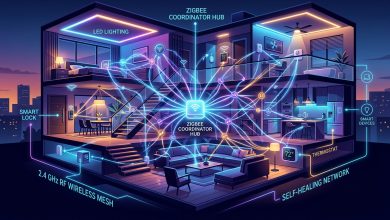



The modern smart home ecosystem has long faced a persistent challenge: fragmentation. Devices from different major ecosystems—such as Amazon Alexa, Google Assistant, and Apple HomeKit—often speak entirely different dialects. A ZigBee-based smart bulb could not natively communicate with a Google ecosystem without a specialized gateway or bridge translating the commands.
To bridge this massive industry gap and eliminate communication barriers between competing IoT protocols, the ZigBee Alliance introduced a groundbreaking solution: Dotdot.
What is Dotdot?
Dotdot is the universal language for smart home devices, born directly from the proven ZigBee Cluster Library (ZCL).
While ZigBee defined how devices communicate over the air using the IEEE 802.15.4 physical layer, Dotdot abstracted that communication upward into a universal application layer. Introduced to the public at CES 2017, Dotdot was designed as an open-source framework allowing smart home manufacturers to utilize the robust software architecture of ZigBee regardless of the underlying hardware transport layer.
In simple terms, Dotdot gave smart devices a shared vocabulary. Whether a device communicated via Thread, Wi-Fi, Bluetooth, or traditional ZigBee mesh, Dotdot enabled it to express states, data, and commands—such as turning on a light, adjusting a thermostat, or checking a lock status—in a language that other compliant devices could immediately understand.
Key Goals and Benefits of Dotdot
- Cross-Platform Compatibility: Designed to allow devices from different manufacturers to interoperate seamlessly, breaking down proprietary silos.
- Open-Source Flexibility: Provided hardware and software developers with a ready-made framework, saving them from reinventing software protocols from scratch.
- Transport Agnostic: Unlike traditional ZigBee, Dotdot was engineered to run over various IP-based networks, integrating smoothly with Internet Protocol (IP) infrastructures.
From Dotdot to Matter: The Ultimate Evolution
The conceptual framework established by Dotdot laid the foundational groundwork for what the smart home industry needed next: a universal, royalty-free standard adopted by all tech giants.
As the Connectivity Standards Alliance (CSA)—formerly the ZigBee Alliance—continued to evolve this vision alongside industry leaders like Apple, Google, Amazon, and Samsung, Dotdot and its underlying IP-based framework evolved directly into what is globally known today as Matter.
Today, Matter fulfills the exact promise that Dotdot set out to achieve: bringing all major tech ecosystems under a single, unified interoperability standard. Devices built on these principles allow consumers to buy smart home hardware with total confidence, knowing it will work effortlessly across any ecosystem they choose, without worrying about brand or protocol lock-in.
#SmartHome #IoT #Dotdot #ZigBee #MatterStandard #HomeAutomation #WirelessTech #SmartLiving