

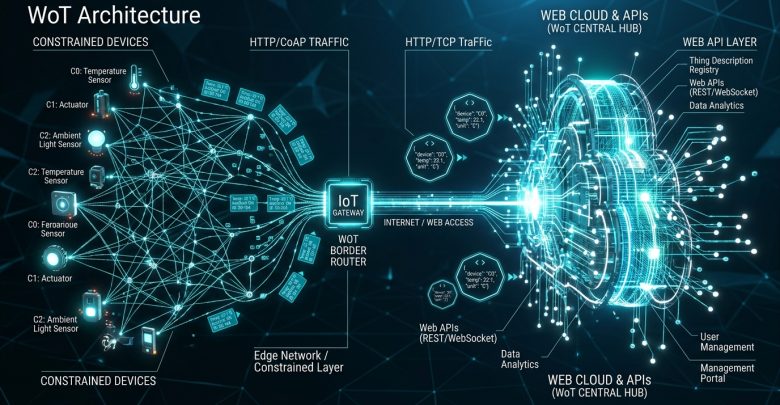
The rapid evolution of the Internet of Things (IoT) is fundamentally changing how we perceive the World Wide Web. As we move toward a future where billions of devices communicate autonomously, the concept of Web of Things (WoT) has emerged as the essential bridge connecting these smart objects to standard web architectures.
The Paradigm Shift: From IoT to WoT
While IoT focuses on the network layer—connecting “things” to the internet—WoT resides in the application layer. Its primary goal is to synchronize and combine data from the physical world using standard web protocols like HTTP and REST, making these devices accessible as web resources.
Key Communication Frameworks
To achieve seamless interaction, the ecosystem relies on several architectural pillars:
- M2M (Machine-to-Machine): Autonomous communication between devices using sensors, RFID, or cellular modules, bypassing human intervention.
- WSN (Wireless Sensor Networks): Low-power networks of small sensors that collect environmental physical data.
- Smart Objects: Objects equipped with computational power and sensors that can “learn” and adapt over time.
The Challenge of Protocols: HTTP vs. CoAP
Traditional web protocols like HTTP (built on TCP) are often too heavy for resource-constrained IoT devices. To bridge this gap, we use:
- RESTful Architecture: A software architecture that simplifies distributed networks through standardized resource interaction.
- CoAP (Constrained Application Protocol): A specialized web transfer protocol designed for low-power devices. It optimizes HTTP concepts for the IoT environment.
- Why CoAP? It is lightweight, supports asynchronous messaging, operates over UDP, and integrates seamlessly with HTTP via proxies.
Classification of IoT Nodes (Resource Constraints)
Not all “things” are created equal. We categorize nodes based on their computational power:
| Class | Capability | Connectivity Strategy |
| Class 0 (C0) | Very limited energy/processing. | Requires Gateways/Proxies to connect. |
| Class 1 (C1) | Limited processing capabilities. | Can connect directly with an IP address. |
| Class 2 (C2) | Minimal limitations. | Capable of using standard internet protocols. |
The Essential Role of IPv6
The explosion of connected devices—projected to reach tens of billions—has rendered IPv4 insufficient due to its address space limitations. The transition to IPv6 is not optional; it is the fundamental requirement to support the addressing needs of 340 undecillion potential devices.
Conclusion: Is IoT Taking Over the Web?
IoT is evolving into an “invisible companion” in human life. By enabling objects to interact, collect data, and learn, WoT will likely influence the future of search engines and SEO in ways we are only beginning to understand. We are moving toward an era where the web is no longer just a collection of pages, but a dynamic, real-time reflection of the physical world.
Tags: #WebOfThings #WoT #IoT #CoAP #RESTful #Networking #IPv6