

The rapid growth of the Internet of Things (IoT) has brought billions of devices online, from autonomous vehicles to smart appliances. However, relying solely on centralized cloud processing for these devices introduces latency that can be critical. Edge Computing solves this by moving computation and data storage closer to the source of data, ensuring faster, more efficient, and more reliable operations.
What is Edge Computing?
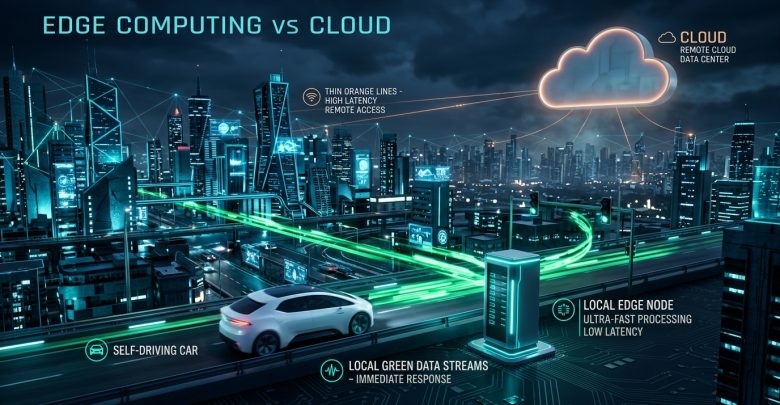
In a traditional cloud-based model, data travels from a device to a distant server, is processed, and then sent back. Edge Computing decentralizes this process, performing data processing at or near the device—the “edge” of the network. This significantly reduces the volume of data transmitted over long distances, minimizing latency and bandwidth consumption.
Why Latency Matters: The Case of Autonomous Vehicles
Consider an autonomous vehicle. In a cloud-only model, the car sends sensor data to a server in a different region and waits for instructions. While this might take only a few seconds, those seconds are an eternity when avoiding an obstacle, such as a pedestrian crossing the road.
The Edge Advantage: A local edge server or onboard processing unit can analyze sensor data and initiate emergency braking in milliseconds. This real-time responsiveness is not just an efficiency upgrade; it is a fundamental safety requirement.
Real-World Applications
1. Smart Homes & Urban Infrastructure
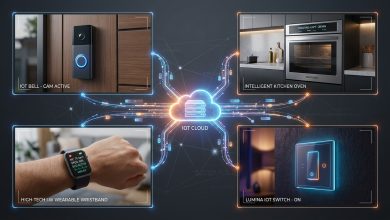
Devices like smart thermostats and voice assistants rely on edge processing for instantaneous responses. Cities are scaling this concept to manage traffic, drones, and Augmented Reality (AR) applications, where local processing ensures seamless, real-time performance.
2. Retail & Security
In a traditional security setup, cameras transmit continuous video feeds to a distant server to detect movement, consuming vast amounts of bandwidth. With edge computing, a smart camera can process the feed locally, deciding whether an event is significant enough to store. This reduces the burden on network infrastructure and protects data privacy by keeping sensitive footage local.
3. Industrial, Energy, & Healthcare
Across industries—from manufacturing and energy grids to defense and healthcare—edge computing is transformative:
- Preventative Maintenance: Sensors on heavy machinery or aircraft can process data locally to detect anomalies immediately after a storm or mechanical stress, alerting crews before a failure occurs.
- Remote Monitoring: Edge-enabled devices can provide critical, life-saving analytics in healthcare without the risk of cloud connectivity drops.
The Hybrid Future: Cloud + Edge
Edge computing does not replace the cloud; it complements it. A robust IoT strategy often employs a hybrid approach:
- Edge: Used for mission-critical, time-sensitive processing (e.g., immediate safety triggers, local filtering).
- Cloud: Used for long-term storage, complex big-data analytics, and machine learning model training that requires massive historical data sets.
Conclusion
Edge computing is the necessary evolution for a truly “intelligent” world. By bringing computation to the edge, we enable devices to act with human-like reflex speeds, making the Internet of Things more robust, efficient, and capable of handling the demands of modern industry.
Tags:
#EdgeComputing #IoT #CloudComputing #Latency #AutonomousVehicles #SmartCity #IndustrialIoT #DataProcessing #RealTimeSystems #TechInnovation