



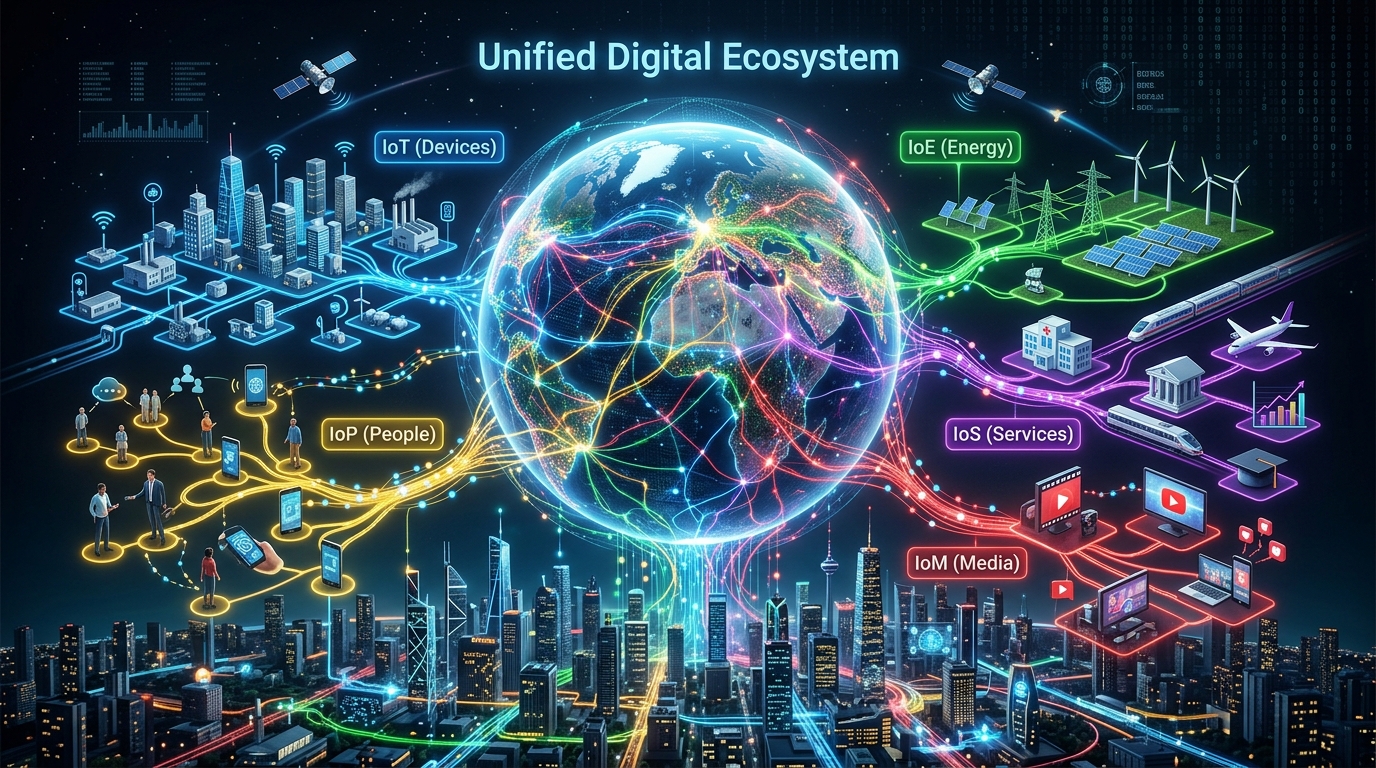
The evolution of the internet has moved far beyond simple connectivity. We are witnessing the emergence of the Internet of Everything (IoE)—an intelligent, interconnected architectural framework designed to bridge the gap between physical objects and information systems. By enabling seamless communication between devices, services, and people, IoE is transforming the digital landscape into a unified, proactive ecosystem.
1. The Core Components of the Unified Network
The future of the internet lies in the integration of specialized “Internets” into a singular, cohesive infrastructure:
- Internet of Things (IoT): The backbone of the physical world, allowing smart objects to sense, communicate, and react to their environment (e.g., smart refrigerators tracking inventory or color-changing umbrellas predicting rain).
- Internet of People (IoP): Connecting users in a borderless digital space. It removes barriers between information producers and consumers, facilitating innovative social and economic activities in real-time.
- Internet of Energy (IoE): A dynamic infrastructure connecting energy networks to the internet. It allows for the local generation, storage, and transmission of energy, optimizing smart building operations and infrastructure.
- Internet of Services (IoS): A software-driven ecosystem utilizing SOA (Service-Oriented Architecture), SaaS, and web services. It automates commercial transactions and resource sharing (skills, data, systems) between providers and consumers.
- Internet of Media (IoM): Focused on advanced video coding and 3D processing, fueling innovations in mobile multi-player gaming, digital photography, and immersive media.
2. Practical Applications in Daily Life
The impact of IoE is already visible in our daily routines:
- Smart Logistics: Enhancing warehouse efficiency through real-time tracking of goods.
- Elderly Care: Empowering remote monitoring and health management for the aging population.
- Smart Living: Appliances that proactively manage household needs, such as a refrigerator notifying a user when groceries are expiring or low.
3. The Digital Economy & Societal Shift
The IoE represents the structural foundation of the Digital Economy and Digital Society. This convergence creates a knowledge-based, innovative society where technological and business dimensions are intrinsically linked.
Key Statistic: By 2020, approximately 16 billion devices were interconnected, averaging about 6 devices per person globally. This underscores the rapid transition into a hyper-connected era where every object, person, and service is a node in a global information network.
Summary of the Integrated IoE Ecosystem
| Component | Focus Area | Primary Benefit |
| IoT | Physical Objects | Automation & Real-time sensing |
| IoP | Human Connectivity | Global knowledge exchange |
| IoE (Energy) | Power Distribution | Efficient, smart energy management |
| IoS | Service Automation | Optimized resource sharing |
| IoM | Media/Data Flow | Immersive digital experiences |
Conclusion
As these networks merge, the barrier between the producer and consumer of data dissolves. This integrated framework is not just a technological advancement; it is the engine of a new economic paradigm where intelligence is distributed, services are automated, and society is more responsive than ever before.
Tags:
#IoE #InternetOfEverything #DigitalEconomy #IoT #IoP #IoS #IoM #SmartCities #FutureTech #DigitalTransformation


با سلام، ممنون از مطلبتون
اگر میشه لطف کنید بحث پروتکل و شبیه ساز ها را بازتر در سایت بیان کنید
سلام و ممنون از این همراهی و نکته سنجی شما، ختما در نظر گرفته میشود
سلام وقت بخیر، ممنون از مطالب شما
سلام وقت بخیر
ممنون از همراهی شما
امیدوارم نظرات مثبت شما را در ادامه مسیر iotjournal داشته باشیم
موفق و پیروز باشید