

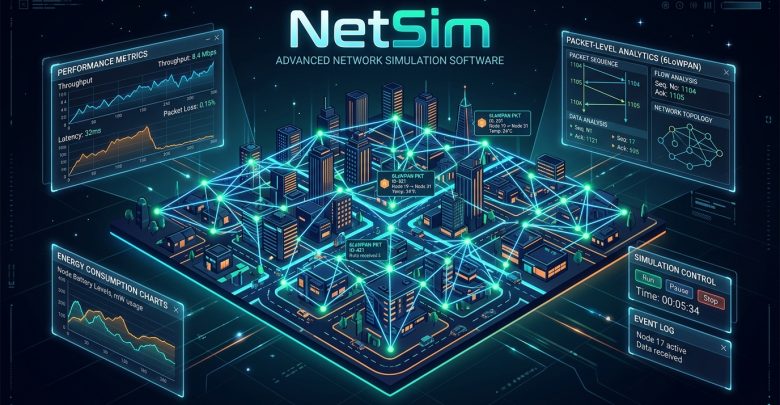
Continuing our exploration of tools and simulators in the Internet of Things (IoT) landscape, we turn our attention to one of the most powerful and advanced network simulation software suites in the world: NetSim (developed by TETCOS). Designed specifically for research, development, academic, and industrial purposes, NetSim enables the precise modeling of wired, wireless, and IoT networks.
What is NetSim?
NetSim is a packet-level network simulation and emulation platform that allows engineers and researchers to test and evaluate the behavior of various network protocols, traffic flows, and complex IoT scenarios prior to physical deployment. Going far beyond a simple graphical simulator, NetSim models every single network node with a complete protocol stack ranging from the application layer down to the physical layer.
Key Features and Capabilities of NetSim in IoT
- Integrated IoT & WSN Modeling: IoT in NetSim is primarily modeled using Wireless Sensor Networks (WSNs), the IEEE 802.15.4 standard (the foundation for protocols like Zigbee), and the 6LoWPAN communication protocol for connecting resource-constrained nodes to the internet.
- Advanced Routing Protocols: Full support for low-power and lossy network routing protocols such as RPL (designed specifically for IoT) and AODV, complete with IPv6 addressing.
- Detailed Energy Model: One of the most critical challenges in IoT is node battery consumption. NetSim tracks energy depletion across various states—Transmit, Receive, Idle, and Sleep—alongside energy harvesting capabilities to accurately estimate network and battery lifespan.
- IoT Gateways (6LoWPAN Gateway): Simulates how sensor data is aggregated by gateways and transmitted through local networks or the internet to cloud servers.
- Open Source Protocol C Code: Unlike many closed commercial simulators, NetSim provides access to protocol source code written in C, allowing researchers to develop and test custom algorithms or proprietary protocols.
- Performance Analysis Tools: Precisely measures metrics such as Throughput, Delay/Latency, Packet Loss Ratio, and Quality of Service (QoS).
- External Tool Integration: Features interfaces to integrate seamlessly with external software like MATLAB, Python, and Wireshark for advanced data analytics.
Pros and Cons of NetSim
- Pros:
- Exceptionally high accuracy in modeling Physical and MAC layers (PHY & MAC) and realistic protocol behaviors.
- Includes a rich array of ready-to-use lab packages and experiments for universities and R&D centers.
- Features 2D and 3D animation tools for dynamic, real-time visualization of packet flows and network traffic.
- Cons:
- It is a high-cost commercial software with no free or open-source community edition (though academic licenses are available at discounted rates).
- Features a relatively steep learning curve, requiring C programming proficiency and deep networking knowledge for advanced use cases.
#IoT #NetSim #NetworkSimulation #WirelessSensorNetworks #Zigbee #6LoWPAN #SmartTech #EmbeddedSystems