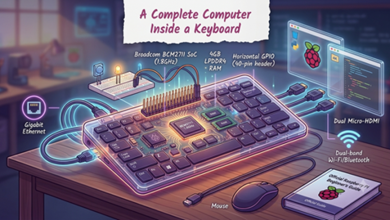



The Raspberry Pi is a credit-card-sized, single-board computer (SBC) developed by the Raspberry Pi Foundation. Originally created to promote computer science education in schools, it has evolved into a powerful tool used by hobbyists, researchers, and engineers worldwide. Produced in Sony’s UK factory, the Pi has democratized computing by offering a fully functional PC experience at a highly accessible price point.
1. Core Features & Capabilities
Despite its tiny form factor, the Raspberry Pi functions like a standard desktop computer, albeit with unique characteristics:
- Booting via SD: It lacks a traditional hard drive, relying on microSD cards to store the operating system and data.
- OS Versatility: It supports a wide array of operating systems, primarily Linux-based distributions like Debian, though Android and even a specialized Windows 10 IoT Core are supported.
- Connectivity: Equipped with USB ports for peripherals (keyboard, mouse), HDMI for HD video and stereo audio output, and a network port (on Model B versions) for internet connectivity.
- Architecture: It utilizes ARM-based CPUs, making it highly power-efficient.
2. Technical Specifications Overview
| Model | CPU Architecture | RAM | Key Highlights |
| Pi 1 | 700MHz ARM | 256MB/512MB/1GB | The foundational model; 1GHz turbo capability. |
| Pi 2 (Model B) | 900MHz Quad-Core A7 | 1GB | Broadcom BCM2836; 4 USB ports. |
| Pi 3 (Model B) | 1.2GHz Quad-Core A53 | 1GB | Built-in Wi-Fi 802.11n & Bluetooth 4.1. |
| Pi Zero | 1GHz Single-Core | 512MB | Ultra-compact, low power, 1 micro-USB. |
3. Applications: From Education to IoT
Because of its small size, low cost, and robust feature set, the Raspberry Pi is a favorite in:
- Robotics: Controlling motor movements and sensors.
- Automation: Managing smart home systems and industrial tasks.
- Internet of Things (IoT): Acting as a gateway or edge computing node for connected devices.
- Scientific Research: Its versatility makes it suitable for data logging, image processing, and academic experiments.
4. Key Takeaways for Developers
- Power Requirements: Models like the Pi 3 require a stable 2.5A power supply to function correctly, especially when peripherals are attached.
- Expandability: While ports are limited, the GPIO (General Purpose Input/Output) pins allow for direct hardware interfacing, and USB hubs can be used to add infinite peripheral support.
- Multimedia: The HDMI output supports high-definition video and audio, allowing the device to be used as a media player or even a tablet when paired with a touchscreen display.
Conclusion
The Raspberry Pi has bridged the gap between complex hardware engineering and accessible software development. Whether you are a student learning to code or an engineer building an industrial IoT network, the Raspberry Pi provides the flexibility and performance needed to bring digital ideas to life.
Tags:
#RaspberryPi #SingleBoardComputer #IoT #EmbeddedSystems #TechEducation #Linux #HardwareDevelopment #Computing #ARM #Innovation