

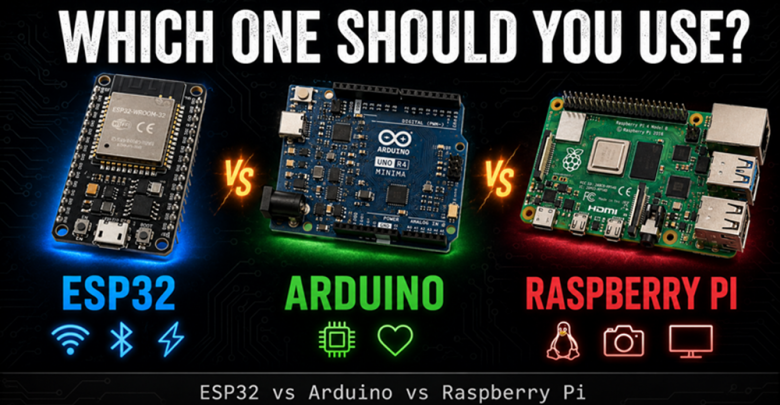
Choosing the right hardware platform is one of the most critical decisions when launching an Internet of Things (IoT) project. The market is dominated by three main contenders: Arduino, ESP32, and Raspberry Pi. While they may look similar to the untrained eye, they are fundamentally different tools designed for entirely different jobs.
Understanding whether your project needs a simple standalone gadget, a power-efficient wireless node, or a multi-tasking edge server will help you select the optimal board.
The Core Difference: Microcontrollers vs. Microprocessors
Before diving into the individual boards, it is essential to understand the primary architectural divide:
- Microcontrollers (Arduino, ESP32): These are single-purpose, bare-metal chips. They do not have an operating system (like Windows or Linux). Instead, they run one piece of firmware in a continuous loop. They boot up instantly (under 300ms), consume minimal power, and excel at directly interacting with hardware sensors, switches, and relays.
- Microprocessors / Single-Board Computers (Raspberry Pi): A Raspberry Pi is a fully functional mini-computer. It runs a complete Linux-based operating system, supports multitasking, handles massive databases, and acts as a central software hub.
Platform Breakdown
1. Arduino: The Beginner-Friendly Standard
Arduino is a massive ecosystem of hardware development boards and software libraries. The classic Arduino Uno uses an 8-bit architecture running at just 16 MHz.
- Best For: Complete beginners, classroom education, simple automation, motor control, and basic sensor reading.
- Pros: Exceptionally rugged, highly stable, massive global community, and simple “plug-and-play” coding.
- Cons: No native Wi-Fi or Bluetooth (requires external shields on older models), very limited RAM and memory, and low processing speeds.
2. ESP32: The Low-Cost IoT Champion
The ESP32 is a 32-bit dual-core powerhouse running at speeds up to 240 MHz. It was built from the ground up specifically for the Internet of Things.
- Best For: Remote sensor nodes, battery-powered IoT devices, wireless smart home setups, and edge data loggers.
- Pros: Built-in Wi-Fi and Bluetooth LE (BLE), ultra-low power deep-sleep modes, very low cost, and fully compatible with the Arduino IDE.
- Cons: 3.3V logic levels require careful wiring, and its 512KB SRAM can fill up fast during heavy network cryptography or complex data operations.
3. Raspberry Pi: The Heavy-Duty Edge Server
The Raspberry Pi (such as the Pi 4 or Pi 5) features a powerful multi-gigahertz quad-core processor and up to 8GB of RAM. It runs full desktop software, manages file networks, and supports advanced programming languages like Python and C++ natively.
- Best For: Smart home hubs (like Home Assistant), local database servers, MQTT gateways, computer vision (OpenCV), and AI workloads.
- Pros: True multitasking, high-speed NVMe/USB 3.0 storage support, native camera/display inputs, and immense computing power.
- Cons: Expensive, high power consumption (unsuitable for long-term battery operations), and complex OS management with a risk of SD card corruption upon abrupt power loss.
Technical Specification Comparison
| Feature | Arduino Uno R3 | ESP32-S3 DevKit | Raspberry Pi 5 |
| Type | Microcontroller | Advanced Microcontroller | Single-Board Computer |
| Clock Speed | 16 MHz | Up to 240 MHz | 2.4 GHz Quad-Core |
| Connectivity | None (Needs Shields) | Native Wi-Fi & Bluetooth | Wi-Fi, BT, Gigabit Ethernet, USB |
| Power Cons. | Very Low (Milliwatts) | Low (Microamps in Deep Sleep) | High (Requires 5V / 5A Adapter) |
| Operating Sys. | None | None (Runs FreeRTOS) | Linux (Raspberry Pi OS) |
Quick Decision Checklist
To determine which hardware family fits your project, ask yourself these three defining questions:
- Does it need to run on a battery or solar panel for months? Choose the ESP32.
- Does it need to run full software stacks, Docker containers, dashboards, or complex databases? Choose the Raspberry Pi.
- Is it a simple offline project meant for basic educational electronics or simple motor logic? Choose the Arduino.
In many production-grade IoT architectures, developers use a hybrid approach: low-power ESP32 microcontrollers are deployed in the field to collect sensor data, which is then transmitted wirelessly to a central Raspberry Pi acting as an edge gateway and data dashboard.
Recommended Technical Deep-Dive Video
For a visual architectural breakdown, check out this guide on ESP32 vs Arduino vs Raspberry Pi. This video provides an embedded hardware analysis covering processing benchmarks, power consumption curves, and real-world industrial deployment scenarios to help you map out your final product hardware stack.
Watch the full video breakdown here:
Tags:
IoT Hardware | ESP32 | Arduino | Raspberry Pi | Microcontroller | Single Board Computer | Smart Home Server | Hardware Architecture | Edge Computing