

The On-Board Diagnostic (OBD) system is the backbone of modern automotive diagnostics. By monitoring engine performance, emissions, and key vehicle components, it provides critical insights that have evolved into a cornerstone of the Internet of Things (IoT) in the automotive sector.
What is OBD?
At its core, OBD is a computer-based electronic system that monitors a vehicle’s primary engine components through inputs from various sensors (e.g., oxygen sensors). The Electronic Control Unit (ECU) processes this data to optimize performance. If a malfunction is detected, the system triggers the Malfunction Indicator Light (MIL)—commonly known as the “Check Engine” light—to alert the owner.
The Evolution: OBD-I vs. OBD-II
- OBD-I (Early 1980s): The first generation used proprietary connectors, hardware interfaces, and protocols. Mechanics needed different, vehicle-specific tools for every brand, making diagnostics highly inefficient.
- OBD-II (Mid-1990s): Introduced as a standard in the mid-90s (mandatory for US vehicles by 1996), OBD-II standardized the Diagnostic Link Connector (DLC) (SAE J1962) and digital communication protocols. This enabled a universal scan tool to communicate with any OBD-II compliant vehicle, regardless of manufacturer.
OBD-II Data Modes (The Language of Diagnostics)
OBD-II communicates through 10 distinct “Modes.” While not every vehicle supports all 10, these modes allow for deep insight into vehicle health:
| Mode | Function |
| Mode 1 | Access to current/live vehicle data (e.g., RPM, fuel status). |
| Mode 2 | Freeze frame data (snapshot of the vehicle at the time of the last fault). |
| Mode 3 | Read Diagnostic Trouble Codes (DTCs). |
| Mode 4 | Clear/Reset DTCs and turn off the MIL. |
| Mode 5 | Oxygen sensor monitoring and test results. |
| Mode 6 | On-board monitoring of other tests. |
| Mode 7 | Request permanent/history trouble codes. |
| Mode 8 | Control of on-board systems/components. |
| Mode 9 | Vehicle identification info (VIN, model, production year). |
| Mode 10 | Access to permanent DTCs. |
The Intersection of OBD-II and IoT: Fleet Management
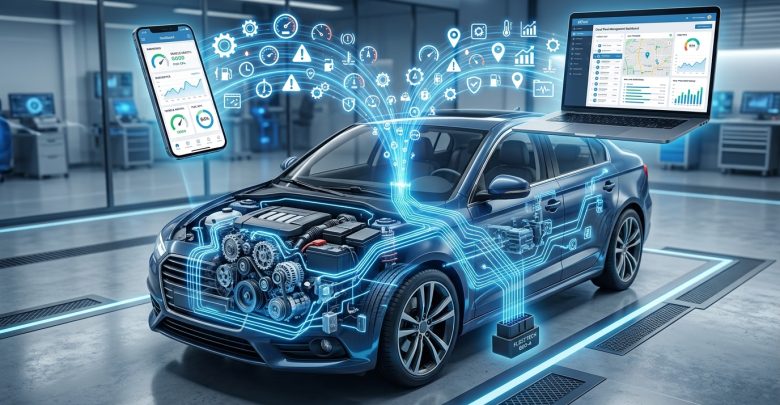
The integration of OBD-II with IoT technology has revolutionized Fleet Management. By connecting an OBD-II dongle to a vehicle’s DLC, transport companies can transform a regular vehicle into a connected IoT node.
Why this matters for Modern Logistics:
- Driver Behavior Monitoring: Using data from the OBD port (speed, harsh braking, acceleration), companies can analyze and improve driver safety and fuel efficiency.
- Real-Time Tracking: Leveraging GPS and smartphone sensors in tandem with OBD-II data allows for granular tracking of fleet movements.
- Predictive Maintenance: IoT systems can alert maintenance crews to potential engine issues before a breakdown occurs, simply by interpreting the diagnostic codes in real-time.
- Scalability: With tens of thousands of drivers already using OBD2 dongles, fleet managers can oversee vast operations with ease, all from a centralized digital interface.
Conclusion
OBD-II is no longer just a tool for mechanics to fix broken engines; it is a vital data source for the modern, connected world. By bridging the gap between vehicle internals and IoT platforms, businesses can reduce operational costs, enhance safety, and move toward a more automated, data-driven future in transportation.
Tags:
#OBD2 #FleetManagement #IoT #AutomotiveTech #VehicleDiagnostics #SmartTransport #DataAnalytics #ECU #ConnectedVehicles