

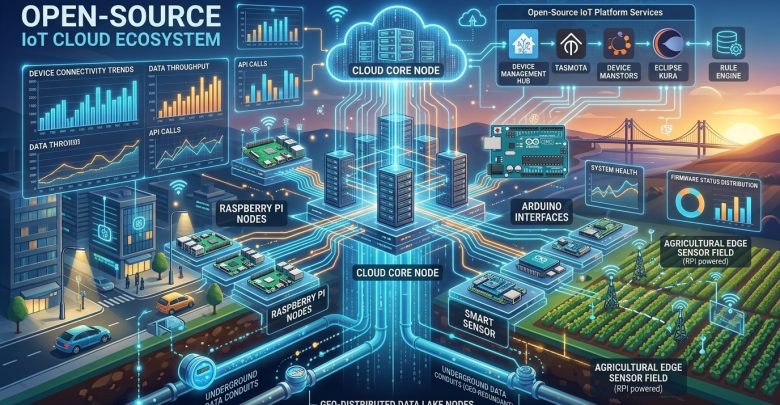
Open-source IoT platforms serve as essential component toolkits that empower developers and enterprises to easily manage connected devices, collect real-time data, and build intelligent applications from remote environments.
Key Open-Source IoT Platforms
1. Kaa IoT Platform
A feature-rich, efficient open-source cloud IoT platform that provides a scalable framework to implement smart product concepts. Kaa supplies robust server environments and endpoint development components to streamline data management.
- Key Features: Supports an unlimited number of connected devices, cross-device compatibility, live device monitoring, remote provisioning/configuration, and real-time sensor data analytics.
2. SiteWhere
Built on the Apache Tomcat application server core, SiteWhere offers a resilient infrastructure for data storage, real-time processing, and cross-device integration, with seamless support for various hacker boards.
- Key Features: Multi-tenant architecture running multiple IoT applications on a single instance, Spring core configuration framework, support for MQTT/AMQP/Stomp protocols, and integrations with MongoDB, HBase, InfluxDB, and Grafana.
3. ThingSpeak
An IoT analytics platform that enables data aggregation, visualization, and manipulation directly via MATLAB analytics without requiring separate MathWorks licenses. It focuses heavily on sensor logging, tracking, and triggers.
- Key Features: Public/private channel data sharing, RESTful and MQTT APIs, automated event scheduling, and advanced MATLAB-powered data computations.
4. DeviceHive
A distributed open-source IoT platform licensed under Apache 2.0. DeviceHive provides flexible deployment options (Docker and Kubernetes) allowing scalability from a single virtual machine to enterprise clusters.
- Key Features: Native Amazon Alexa integration, customizable JavaScript behaviors, big data pipeline support (Apache Spark, Kafka, Cassandra), and comprehensive multi-language libraries.
5. Zetta
An API-first, Node.js-based open-source platform that combines REST APIs, WebSockets, and reactive programming. It can run on small boards, local computers, or cloud environments to build geographically distributed networks.
- Key Features: Powered by Node.js, seamless hacker board compatibility, mobile-cloud-device assembly, and data streaming capabilities into machine intelligence engines like Splunk.
6. Distributed Services Architecture (DSA)
A decentralized, open-source platform and toolkit that unifies devices, services, and applications into a structured, real-time data model to facilitate machine-to-machine logic.
- Key Features: Lightweight NodeAPI modules, DSLink protocol translation libraries, and native cross-platform hardware support (Raspberry Pi, Beaglebone, Android, Windows, OS X).
7. Thingsboard.io
A 100% open-source IoT platform available for cloud (SaaS/PaaS) or on-premises deployment, offering device management, data collection, and visualization.
- Key Features: Over 30 customizable widgets for user dashboards, remote device control, rule engine plugins, multi-tenant installation support, and robust transport encryption (MQTT/HTTP).
8. Thinger.io
An open-source scalable cloud infrastructure designed for connecting devices via an administration console or custom project logic using REST APIs.
- Key Features: Real-time dashboards, Docker and IFTTT integration, cloud-ready deployment, and open-source libraries for diverse hardware like Arduino, ESP8266, and Raspberry Pi.
9. WSO2 IoT
An enterprise-grade open-source platform for IoT and mobile projects powered at the edge by WSO2 Siddhi, offering robust API generation capabilities.
- Key Features: Real-time and predictive analytics via WSO2 Data Analytics Server (DAS), geo-fencing capabilities, multi-protocol support (MQTT, HTTP, XMPP, WebSockets), and automated device enrollment.
Comprehensive Comparison Table of Open-Source IoT Platforms
| Platform | Device Management? | Integration Options | Security Protocols | Data Collection Protocols | Analytics Support | Visualization Support? | Default Database |
| Kaa | Yes | Portable SDK, REST API | SSL Link Encryption, RSA 2048-bit, AES 256-bit | MQTT, CoAP, XMPP, TCP, HTTP | Real-time IoT Data Analytics & Visualization | Yes | MongoDB, Cassandra, Hadoop, Oracle NoSQL |
| SiteWhere | Yes | REST API, Mule AnyPoint | SSL, Spring Security | MQTT, AMQP, Stomp, WebSockets | Real-time analytics (Apache Spark) | No | MongoDB, HBase, InfluxDB |
| ThingSpeak | No | REST & MQTT APIs | Basic Authentication | HTTP | MATLAB Analytics | No | MySQL |
| DeviceHive | Unknown | REST & MQTT APIs | JWT (JSON Web Tokens) | REST API, WebSockets, MQTT | Real-time analytics (Apache Spark) | Yes | PostgreSQL, SAP Hana DB |
| Zetta | No | REST APIs | Basic Authentication | HTTP | Splunk integration | No | Unknown |
| DSA | No | REST APIs | Basic Authentication | HTTP | None | No | ETSDB (Embedded Time Series) |
| Thingsboard.io | Yes | REST APIs | Basic Authentication | MQTT, CoAP, HTTP | Real-time analytics (Kafka, Spark) | Yes | Cassandra |
| Thinger.io | Yes | REST APIs | SSL/TLS & Basic Auth | MQTT, CoAP, HTTP | Basic processing | Yes | MongoDB |
| WSO2 | Yes | REST APIs | SSL & Basic Auth | HTTP, WSO2 ESB, MQTT | WSO2 Data Analytics Server (DAS) | Yes | Oracle, PostgreSQL, MySQL, MS SQL |
Alternative Mention: IoTgo
Originally developed as an open-source IoT cloud service framework by ITEAD Studio (allowing users to deploy private cloud instances similar to self-hosted software like WordPress), the name “IoTgo” is also utilized in modern enterprise ecosystems (such as Giesecke+Devrient’s IoTgo® Control and IoTgo® Smart Label tracking solutions).
#OpenSource #IoT #IoTPlatforms #EdgeComputing #SmartDevices #TechTrends