
How Different Industries Leverage the Internet of Things (IoT): Insights from Forbes

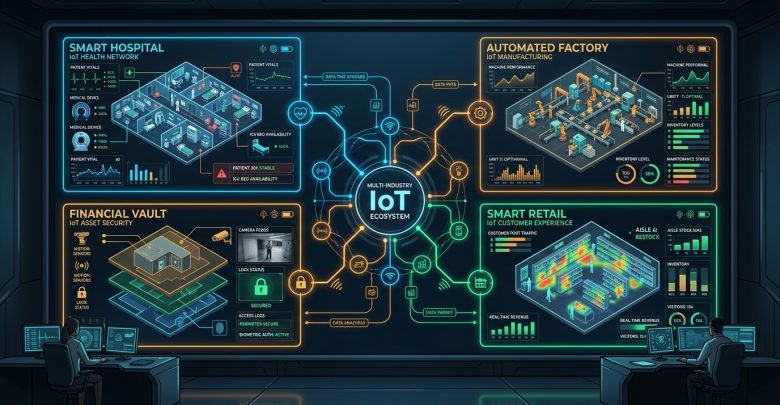
Because the Internet of Things (IoT) is applied differently across various sectors, there is no single, uniform way to define it. To better understand the real-world impact of IoT, Forbes surveyed 700 executives experienced in implementing IoT programs within their organizations.
The findings reveal that financial services, healthcare, and industrial manufacturing are leading the charge, frequently integrating IoT capabilities with advanced analytics and artificial intelligence (AI). Nearly 6 out of 10 executives in financial services (58%) and 55% in healthcare reported taking advanced actions in this domain.
Here is how leaders across seven key industries are using IoT to drive progress:
1. Telecommunications
For telecom companies, the mobile revolution serves as a natural stepping stone toward IoT adoption. Approximately half of the surveyed telecom companies have integrated IoT into their core processes or key business areas.
- Top Data Sources: Audio devices and mobile phones (42%).
- Primary Focus: Increasing employee productivity (40%).
- Advanced Usage: Over a third of telecom firms use computer-driven analytics on the front lines to better predict customer behavior and asset profitability.
2. Energy
Energy companies frequently manage operations in remote regions—such as oil and gas fields—requiring continuous, round-the-clock monitoring. Nearly half of energy executives (47%) have deployed IoT across selected business areas.
- Core Objectives: Monitoring asset performance, enhancing customer experience, and maximizing overall operational efficiency.
- Visual Analytics: About 34% of companies use in-house visual analytics. For instance, drone fleets equipped with cameras help monitor field and facility safety, identifying anomalies before they escalate into major hazards.
3. Financial Services
Financial institutions possess a high level of security awareness, driving heavy reliance on connected security cameras and imaging sensors to safeguard facilities. Financial services lead global IoT adoption, with 58% of respondents having implemented these capabilities to some degree.
- Visual Analytics Leaders: 51% of financial firms have deployed AI-driven cameras and visual analysis systems.
- Core Goals: Expanding network connectivity (31%) and boosting security (30%).
4. Healthcare
Healthcare organizations focus heavily on patient experiences—whether as patients, in waiting rooms, or in emergency departments. Ranking among the frontrunners in IoT adoption, the sector relies heavily on mobile technology.
- Core Tools: Audio devices and mobile phones are utilized by 46% of respondents.
- Primary Applications: Staff monitoring, facility oversight, and patient experience enhancement.
- Visual Analytics: 57% of healthcare organizations leverage visual analytics to elevate patient care and service quality.
5. Industrial Manufacturing
Manufacturers depend heavily on massive machinery, making real-time performance insights critical. Manufacturers experience some of the most profound transformations driven by IoT.
- Business Impact: A majority of manufacturing executives (51%) strongly agree that IoT has unlocked entirely new business avenues, with 29% noting it has enabled them to roll out new products and services.
- Adoption Rates: 51% have deployed IoT widely or across selected business areas, while 52% utilize visual analytics for real-time asset and product tracking.
- Data Sources: Mobile phones and computer systems serve as primary data streams.
6. Retail
In retail, understanding in-store customer behavior and reactions on the shop floor is critical. Half of all retail executives surveyed reported making significant strides in IoT implementation.
- Primary Focus: Utilizing visual analytics to gain deeper insights into customer preferences, shopping habits, and behaviors.
- Top Data Sources: Computer systems and physical sensors.
7. Transportation
Transportation is inherently about movement and logistics, and IoT systems play a pivotal role in optimizing these operations.
- Primary Use Cases: Boosting logistics efficiency, tracking shipments, and optimizing routing and fleet management.
Conclusion
As these insights demonstrate, virtually every industry holds immense potential to benefit from IoT. However, unlocking this potential ultimately depends on forward-thinking executives who can recognize these technological capabilities and tailor them effectively to their specific organizational needs.
#IoT #InternetOfThings #ForbesInsights #SmartIndustry #DigitalTransformation #TechTrends #SmartHealthcare #Fintech #IndustrialIoT #RetailTech