

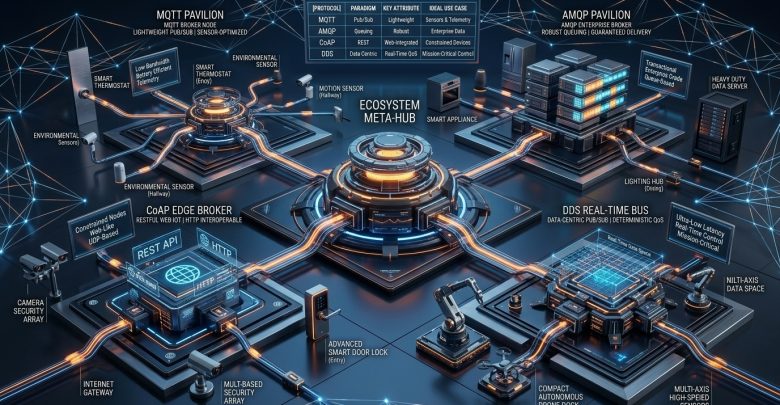
Choosing the right communication protocol is one of the core pillars of designing Internet of Things (IoT) systems. While some protocols are designed for simplicity and thus support only a limited set of use cases, standards like DDS are feature-rich, seamlessly managing many complexities of data connectivity and reducing developer effort.
The table above illustrates a qualitative comparison of several prominent IoT standards. Below is a detailed breakdown of these key messaging and data-sharing protocols:
1. MQTT
- Paradigm & Operation: A broker-dependent publish/messaging protocol designed for TCP/IP, supporting multiple brokers and multiple subscribers or clients.
- Transport Layer: TCP/IP
- Scope: Device-to-Cloud (D2C)
- Discovery: No
- Security & Fault Tolerance: Uses TLS for security, and from a fault tolerance perspective, the broker acts as a Single Point of Failure (SPOF).
2. AMQP
- Paradigm & Operation: An efficient, binary, unified, point-to-point protocol defined for transmitting messages between two network processes (typically a client and a broker).
- Transport Layer: TCP/IP
- Scope: Supports D2D (Device-to-Device), D2C, and C2C (Cloud-to-Cloud).
- Discovery: No
- Security & Fault Tolerance: Relies on TLS, with implementation-specific fault tolerance.
3. CoAP
- Paradigm & Operation: A software protocol based on a request/reply (REST) model designed to support simple connections between low-power electronic devices (such as wireless sensors) and internet-based systems (client-server architecture).
- Transport Layer: UDP/IP
- Scope: Device-to-Device (D2D)
- Discovery: Yes
- Security & Fault Tolerance: Uses DTLS and features a decentralized fault tolerance architecture.
4. DDS
- Paradigm & Operation: A feature-rich standard that transparently handles many data connectivity complexities in IoT systems, thereby reducing developer effort. It supports both Publish/Subscribe and Request/Reply paradigms.
- Transport Layer: UDP/IP (unicast + mcast) and TCP/IP
- Scope: Full support for D2D, D2C, and C2C.
- Discovery: Yes
- Advanced Features: Includes content-based routing and queries, encoding declarations, transport priorities, comprehensive security options (TLS, DTLS, DDS Security), and decentralized fault tolerance.
#MQTT #AMQP #CoAP #DDS #IoT #WirelessProtocols #NetworkProtocols #InternetOfThings #TechStandards #M2M