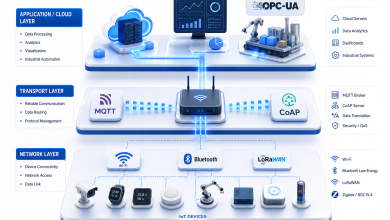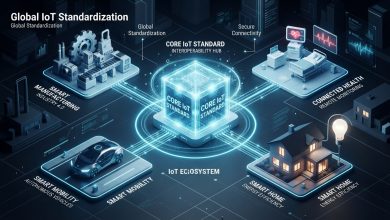



Standardization in the Internet of Things (IoT) encompasses various domains—such as wireless communications, technical implementations, application layers, and quality of service. Consequently, numerous organizations and institutions are involved in its development. Below is an overview of key IoT standards and protocols categorized by their operational layers:
1. Communication / Transport Layer
- Ethernet: Standard wired networking technology.
- WirelessHART: Provides a robust wireless protocol for a wide range of measurement, control, and asset management applications.
- DigiMesh: A proprietary peer-to-peer wireless networking topology used in wireless mesh solutions.
- ISA100.11a: A wireless network technology standard developed by the International Society of Automation (ISA) for industrial automation: process control and related applications.
- IEEE 802.15.4: Specifies the physical layer and media access control for Low-Rate Wireless Personal Area Networks (LR-WPANs). Maintained by the IEEE 802.15 working group, it serves as the foundation for ZigBee, ISA100.11a, WirelessHART, and MiWi, extending through upper layers not defined in 802.15.4 or combined with 6LoWPAN and standard IP for an embedded wireless internet.
- NFC: Based on ISO/IEC 18092:2004 using inductively coupled devices at a central frequency of 13.56 MHz, offering data rates up to 424 kbps and a short range of a few meters compared to wireless sensors.
- ANT: A proprietary wireless sensor network technology providing a wireless communication protocol operating in the 2.4 GHz ISM RF spectrum band to handle association, data display, signaling, authentication, and error detection.
- Bluetooth: Operates in the 2.4 GHz ISM band using frequency hopping, with data rates up to 3 Mbps and a maximum range of 100 meters.
- Eddystone: A protocol defining a Bluetooth Low Energy (BLE) short message format for proximity messages.
- ZigBee: Utilizes the 802.15.4 standard, operating at 2.4 GHz with 250 kbps, supporting up to 1024 nodes per network with a range of up to 200 meters and 128-bit AES encryption.
- EnOcean: An energy-harvesting wireless technology operating at 868 MHz (Europe) and 315 MHz (North America) with transmission ranges up to 30 meters indoors and 300 meters outdoors.
- WiMax: Based on the IEEE 802.16 standard intended for wireless metropolitan area networks, offering ranges up to 50 km for fixed stations and 5–15 km for mobile devices, operating between 2.5 GHz and 5.8 GHz with data rates up to 40 Mbps.
LPWAN Standards (Low-Power Wide-Area Network):
- Weightless: A proprietary open wireless technology standard for exchanging data between a base station and thousands of surrounding devices using TV whitespace channels with high security.
- NB-IoT: Narrowband IoT technology standardized by the 3GPP standards organization.
- LTE-MTC: (LTE-Machine Type Communication) A family of technology standards supporting categories like Cat-1 and Cat-M1 suited for IoT.
- EC-GSM-IoT: (Extended Coverage GSM IoT) Provides new cellular network capabilities for LPWA IoT applications, deployable via software across a massive GSM footprint.
- LoRaWAN: A protocol designed to support battery-powered wireless nodes in regional, national, or global networks.
- RPMA: (Random Phase Multiple Access) A communication system technology using Direct Sequence Spread Spectrum (DSSS) with multiple access.
2. Semantic Standards
- IOTDB: JSON / Linked Data standards used to describe the Internet of Things.
- SensorML: Provides standard models and XML encodings to describe sensors and measurement processes.
- Semantic Sensor Net Ontology (W3C): Describes sensors, observations, and related concepts without covering domains, time, or locations natively, but imports other core ontologies via OWL.
- Wolfram Language – Connected Devices: Symbolic representation of any device coupled with standard Wolfram functions (such as DeviceRead, DeviceExecute, DeviceReadBuffer, DeviceReadTimeSeries) to perform device operations.
- RAML: (RESTful API Modeling Language) Simplifies the entire API lifecycle from design to sharing in a concise, reusable manner.
- SENML: (Sensor Markup Language media types) Allows simple sensors (like a temperature sensor) to use media types within protocols like HTTP or CoAP to transmit sensor measurements or configurations.
- LsDL: (Lemonbeat Smart Device Language) An XML-based device language tailored for service-oriented devices.
3. Multi-layer Frameworks
- AllJoyn: An open-source software framework enabling devices and apps to easily discover and communicate with each other.
- IoTivity: An open-source project hosted by the Linux Foundation and supported by the Open Connectivity Foundation (OCF/OIC).
- IEEE P2413: Standard for an architectural framework for the Internet of Things (IoT).
- Thread: Built on open standards and IPv6 technology using 6LoWPAN as its foundation.
- IPSO Application Framework: Defines a set of REST interfaces allowing smart objects to expose resources, communicate with other smart objects, and interface with backend services.
- OMA LightweightM2M v1.0: Designed as a fast, expandable device management and service/application data-transmitting protocol for machine-to-machine communication.
- Weave: A communication platform for IoT devices handling device setup, phone-to-device communication, and mobile/web user interactions.
- Telehash: A secure wire protocol enabling a decentralized overlay network for applications and devices using JSON, UDP, and DHT.
4. Security Protocols
- Open Trust Protocol (OTrP): A protocol for installing, updating, and deleting applications and managing security configurations within a Trusted Execution Environment (TEE).
- X.509: A Public Key Infrastructure (PKI) standard for managing digital certificates and public-key cryptography, widely used in transport layer security for web and email protection.
5. Vertical Specific Standards
- IEEE 1451: A family of smart transducer interface standards defining open, common, network-independent communication interfaces for connecting transducers (sensors/actuators) to microprocessors and control networks.
- IEEE 1888.3-2013: IEEE standard for ubiquitous green community control network security.
- IEEE 1905.1-2013: IEEE standard for a convergent digital home network for heterogeneous technologies.
- IEEE 802.16p-2012: IEEE standard air interface for broadband wireless access systems.
- IEEE 1377-2012: IEEE standard for utility industry application layer communication protocol.
- IEEE P1828: Standard for systems with integrated components.
- IEEE P1856: Standard framework for electronic system health management and prevention.
#IoT #WirelessProtocols #NetworkProtocols #InternetOfThings #TechStandards #SmartDevices #LPWAN #EmbeddedSystems