


In the evolving landscape of the Internet of Things (IoT), operating systems designed for constrained devices are essential. Contiki OS stands out as a leading open-source, lightweight operating system tailored for IoT devices with limited memory, processing power, and bandwidth. Coupled with the Cooja network simulator, it provides a comprehensive environment for research, development, and security analysis.
Contiki OS: Architecture for Constrained IoT
Contiki is designed for minimalism, fitting a full suite of modern networking tools—including a web server, email client, and shell—into approximately 30 KB of code. Its popularity stems from its maturity, flexibility, and efficiency.
Key Communication Protocols
Contiki supports a robust stack for diverse IoT requirements:
- uIPv6: A full-featured IPv6 implementation for 8-bit and 16-bit microcontrollers.
- 6LoWPAN: Enables IPv6 over low-power wireless personal area networks, using compression to optimize data transmission.
- RPL (Routing Protocol for LLNs): An IPv6-based routing protocol that builds a Destination-Oriented Directed Acyclic Graph (DODAG) to find the most efficient paths in complex, lossy networks.
- CoAP: A specialized web transfer protocol for resource-constrained devices, ideal for remote monitoring.
- Rime: A custom stack providing alternative primitives for low-power systems when IPv6/IPv4 are not utilized.
Cooja: Network Simulation & Analysis
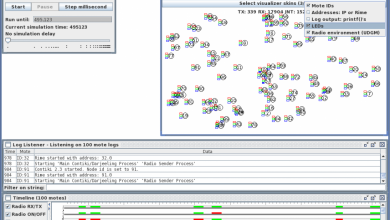
Cooja allows developers to simulate full Contiki systems. It is instrumental for testing firmware before deploying it to physical hardware.
Workflow in Cooja:
- Mote Creation: Create new node types via Motes → Add Motes → Create New Mote Type.
- Simulation & Monitoring: Use the Mote Output window to monitor real-time logs and signals.
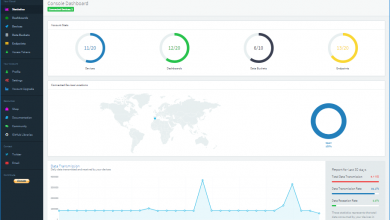
- Data Analytics: Use Collect View to analyze individual Mote parameters like temperature, power consumption (CPU, Radio Listen/Transmit), and latency.
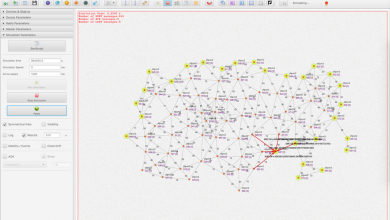
- Network Visualization: The Network Graph tab allows researchers to view dynamic topology and inter-node connections.
Security Challenges in IoT
As IoT expands into smart cities, logistics, and industrial control, security becomes a primary concern. The interconnected nature of these devices makes them susceptible to various attacks:
- DoS/DDoS Attacks: Attackers flood channels or bandwidth, rendering the network unusable for legitimate nodes.
- Sybil Attacks: A malicious node creates multiple fake identities to deceive other nodes and disrupt network traffic.
- Node Impersonation: A malicious device steals the identity of a legitimate node to inject false data or capture secure packets.
- Application-Level Attacks: Manipulation of application logic (e.g., misrepresenting traffic conditions in an IoV scenario to cause congestion).
Security Mitigation: Implementing IPv6 with dynamic dual encryption and public-key cryptography is critical to ensuring packet integrity and preventing unauthorized network intrusion.
Advanced Analysis with Foren6
For deep analysis of 6LoWPAN traffic, Foren6 is an indispensable open-source tool. It integrates with sniffers to capture and visualize network exchanges in real-time.
Installation Quick-Start:
Bash
# Configure dependencies
sudo apt-get install -y qt4-qmake libqt4-dev make libexpat1-dev cmake libpcap0.8-dev libc6-dev tshark gcc g++

# Clone and build
git clone http://github.com/cetic/foren6.git
cd foren6
make
sudo make install
Research Opportunities in IoT
The research potential within Contiki and Cooja is vast. Key areas for development include:
- Interoperability: Enhancing communication across different IoT protocols.
- Energy Awareness: Designing routing algorithms that minimize power consumption to extend device longevity.
- Threat Detection: Developing predictive models to detect and avoid energy-depletion attacks.
- Adaptive Systems: Creating reusable implementations that support multiple user interfaces for complex industrial environments.
Tags:
#ContikiOS #Cooja #IoT #6LoWPAN #RPL #NetworkSimulation #IoT_Security #EmbeddedSystems #SmartCity #WirelessProtocols